|
Controlled burning out of
control in northern Australia
|
|
 |
| Controlled
burning in Australia’s north has exploded, sparking
fierce debate between environmentalists, traditional
owners and tourist operators |
|
|
|
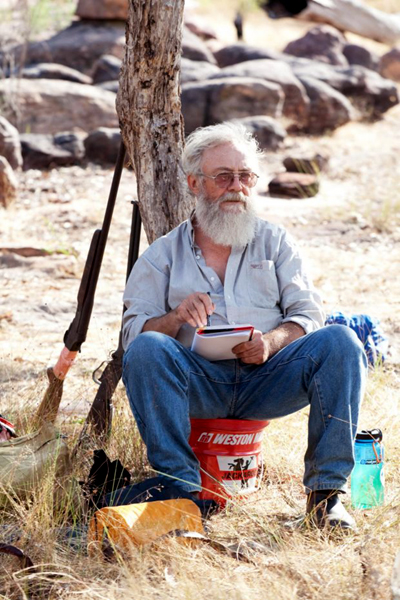
Peter
Cooke helped found the Aboriginal fire-abatement project
in the Northern Territory Photo: David Hancock
|
|
By Chris Ray
First published in the Sydney Morning Herald,
20 January 2018
Sydney, January 24: It was June 2014, bushwalkers were camped at a little
creek in the remote and ruggedly beautiful Kimberley region of Western
Australia.
Rosemary McDonald awoke to a generator like roar, her mesh tent lit
by a vivid glow.
Red-tipped flames ballooned into the night sky on the nearby ridge.
Rosemary and her husband, Mike, hurriedly pulled on pants and boots,
shouting, "Get up! Quickly!" to the other eight campers.
"An enormous fire was heading straight for us," Rosemary recalls.
"We had about 15 minutes before it hit," she said.
Surrounded by dense cane grass that acts like rocket fuel, and dangerously
exposed, they abandoned their tents and grabbed the essentials: torches,
water, food, cooking pots, sleeping bags.
"We ran for our lives."
"One poor woman didn't have time to get dressed."
Within minutes they saw another approaching fire front, "massive
and really terrifying".
The hikers were experienced and didn't panic.
They had used GPS plotting to mark their outward journey waypoints on
a map. And they were lucky: a full moon helped them retreat to the safety
of a deep gorge.
The group was dismayed by the amount of fire they saw during that fortnight
sailing and walking around the Buccaneer and Bonaparte archipelagos
in Australia's extreme north-west.
"The land was lit up like Mordor in Lord of the Rings," wrote
one member later in his bushwalking club newsletter.
Rosemary has seen fires on most of her 10 Kimberley walks "but
I still get goosebumps thinking about that one.
It's magic country, but you can never really relax because fire can
come from anywhere."
Bushwalkers on land where authorised seasonal burning was underway
The bushwalkers were on Aboriginal land where the Dambimangari traditional
owners and Kimberley Land Council (KLC) were carrying out seasonal burning,
according to the West Australian government.
Both the government and KLC have suggested the group put themselves
in danger by walking on Dambimangari territory without permission.
Travel anywhere in Australia's north and you are likely to see signs
of large-scale, deliberate burning on public land, including national
parks, cattle stations and Aboriginal land.
Every March or April, as vegetation that flourishes during the annual
wet season begins to dry, landholders from Broome to Townsville start
to burn the tropical savannas.
Vast grasslands and woodlands cover a quarter of mainland
Australia
In the Kimberley alone, fires are lit by the WA Department of Parks
and Wildlife – which burns conservation areas and, with permission,
Aboriginal land – as well as by the WA Department of Fire
and Emergency Services, local councils, pastoralists, and Indigenous
landowners.
The burning, which lasts several months, is done to reduce fuel loads
and create fire breaks before the late dry season, when waterholes dry
up, grass turns brown and uncontrolled bushfires threaten.
The Kimberley is magic country, but you can never really relax because
fire can come from anywhere.
In the Kimberley, for instance, "cool, patchy burns" by Aboriginal
rangers – where overnight dew limits the spread of flames –
help to limit wildfires, while ensuring there's enough vegetation for
rare animals like the endangered Gouldian finch to survive, according
to KLC chief executive Nolan Hunter.
Wildfires can be ignited by lightning or human agency – a cigarette
butt, a fisherman's campfire, a spark from a grader blade – and
Australia's north has few ploughed fields, permanent rivers, cities
and roads capable of stopping them.
Bushfire threats end with the arrival of monsoon rains
Critics, however, say too much land is burnt too often and fighting
fire with fire often worsens the problems it's supposed to mitigate:
the loss of habitat, species decline, erosion, flooding and destruction
of Indigenous rock art.
Northern fire management involves many actors who deliver uneven performances.
However, fire regimes in much of the Kimberley and in Northern Territory
national parks, such as the Top End's most visited attraction, Kakadu,
come in for strong criticism.
Aboriginal-owned Arnhem Land, which borders Kakadu, is seen as doing
much better.
The fire issue divides environmentalists, ecologists and archaeologists.
Opposition from tourism operators and bushwalkers has simmered for years.
New industry - savanna carbon farming
The advent of a new industry in the past decade – savanna carbon
farming, with landowners paid to burn the bush early in the season –
has sharpened divisions.
Late dry-season fires emit higher levels of greenhouse gases than early
ones.
The measurable gap has given rise to savanna carbon abatement projects
– 80 so far – that sell credits to the federal government's
$2.55 billion Emissions Reduction Fund, an initiative of the Abbott
government, as well as businesses that want to offset their own emissions.
The projects generate tens of millions of dollars for Aboriginal
communities which, in the Northern Territory, operate more than half
of all carbon abatement schemes.
Others are run by pastoralists who have always burnt to promote fresh
grass and see carbon trading as a new income source.
Savanna carbon farming has even become an export business, offering
an international solution to unrestrained wildfires that worsen global
warming.
The Aboriginal Carbon Fund, a not-for-profit company aimed at building
an Indigenous carbon industry, has signed an agreement to share information
with a Canadian First Nations group about how it's done.
KLC will join an Australian government-funded project to implement savanna
burning pilot schemes in Botswana, southern Africa.
Prescribed burning threatens nature parks
Russell Willis has run a bushwalking business out of Darwin for 30 years
and sits on the Kakadu Tourism Consultative Committee.
A few months ago, he warned the committee that unless prescribed burning
is curtailed "there will be no park to preserve.
The group I took on a walk in July will go home and tell people about
walking through ash."
The week-long route through woodlands and over rock plateaux was almost
entirely burnt, he said.
Willis told readers in his bushwalking-related newsletter that prescribed
burning was also devastating the Kimberley, warning: "If something
doesn't change, the north Australian woodlands could be gone in a generation."
He urged them to lobby Qantas to stop buying carbon credits generated
by savanna burning.
Qantas passengers can opt to pay a few dollars on top of their
ticket price to offset aircraft emissions.
Some of the money goes to traditional-owner groups under the North Kimberley
Fire Abatement Project.
Qantas promotes the scheme as reducing emissions "through traditional
fire management techniques".
Willis says: "That's bullshit.
When I flew out from a Kimberley walk on July 1, we could see dozens
of fires, all man-made, burning huge areas.
Why are they so keen to burn?
They get paid to do so."
Willis's newsletter caused a stir.
Kimberley Rock art destroyed by prescribed burning
The chairperson of the North Kimberley Land Conservation District Committee,
Cecilia Myers, told him in a letter in August 2017 that his statements
were "destructive and divisive", and that land managers were
motivated not by money but by the need to control "intense, damaging"
late-season fires.
Myers, an archaeologist and director of a pastoral company with Kimberley
properties that carbon trade through savanna burning, added that early-season
burning, usually by air, was the best way to limit the threat to biodiversity,
infrastructure and pastoral productivity from late-season fires.
Rock paintings survived for millennia because their owners protectively
burnt surrounding vegetation.
Not all archaeologists would agree that current fire practices guarantee
the same result.
"Massive aerial burning" is fading and scorching rock art
across the Kimberley, according to Lee Scott-Virtue, who runs a Kimberley-focused
archaeological consultancy.
She estimates fire, especially burning by the Department of Parks and
Wildlife, has destroyed about 30 per cent of the thousands of ochre
images she recorded around the distinctive cone towers of the Bungle
Bungle ranges in 1983.
Scott-Virtue's Aboriginal colleague, elder Ju Ju "Burriwee"
Wilson, told Fairfax Media in 2014 that she felt "sad, wild, very
angry" to see her ancestors' work destroyed by "government"
burn-offs.
A protective biofilm – a mixture of pigmented fungi and bacteria
– has kept Australia's oldest art, the mysterious Bradshaw figures
found only in parts of the Kimberley, vibrant for more than 30,000 years.
"Fire is rapidly fading these extraordinary images and exfoliating
the rocks they're painted on," Scott-Virtue says.
"Fire is managed a lot better in Arnhem Land, where Aboriginal
people were not displaced to the extent and in the way they were in
the Kimberley."
A 2014 survey by academics from Perth's Edith Cowan and Murdoch universities
revealed strong opposition to the Kimberley's fire regime among long-term
residents of Kununurra, 300 kilometres north of the Bungle Bungles.
Kununurra trekking guide John Storey says: "I have lived in the
Kimberley for 37 years and walk a lot of the country each year.
I have seen the landscapes change from dense woodland with understorey
and cover, to no understorey, no dead wood and very little wildlife."
Qantas urged to abandon fire-abatement project
Storey wrote to Qantas CEO Alan Joyce, urging him to abandon fire-abatement
projects.
"The incendiaries are dropped in the mornings in these strong winds
and burn for weeks, destroying huge areas of country.
There is nothing controlled about these burns, and much of the same
country gets repeatedly burnt each year," Storey wrote.
He says he received no reply from Qantas, which did not reply to a request
for comment.
Lake Argyle, an immense reservoir formed by the damming of the Ord River,
is on the itinerary of every tourist in the eastern Kimberley.
Prescribed burning destors more vegetation than lightening or arson
Charlie Sharpe, the 48-year-old owner and manager of the lake's popular
resort, was born in the region.
He claims prescribed burning by the Department of Parks and Wildlife
and Aboriginal rangers has destroyed more vegetation than lightning,
arson and accident ever did and causes "massive erosion".
Sharpe says prescribed burning has promoted fire-dependent grasses at
the expense of spinifex and small shrubs.
"The landscape is dramatically different to what it was 40 years
ago," he says.
"Lake Argyle is silting up because all the country in the catchment
is being burnt every single bloody year.
Instead of training Indigenous rangers to throw incendiaries out of
helicopters, we should be training them how to put fires out.
Let's teach people it's not okay to destroy the bush."
Such criticism is "misinformed", says KLC's Nolan Hunter.
"[Critics] don't realise the sophistication of our people who have
accredited training, safety instruction, an understanding of the science."
Support for savanna carbon farming
David Bowman, professor of environmental change biology at the University
of Tasmania, supports savanna carbon farming "in principle"
but says land managers have become "fixated" on the timing
of burns, making it "extremely difficult to have a free and frank
conversation about what works and doesn't work in fire management".
He adds, "Allegedly good fire regimes are still having significant
negative ecological impacts. They have missed the point that the best
thing you can do for wildlife is to maximise the extent of unburnt habitats."
Foreign minister Julie Bishop is bullish about opportunities to export
Indigenous fire expertise and Australia's emissions accounting capability.
But it wasn't long ago that Aboriginal fire management was disparaged.
West Arnhem Land Fire Abatement project
Peter Cooke helped set up the Aboriginal-owned West Arnhem Land Fire
Abatement project.
It has sold carbon credits to multinational oil and gas company ConocoPhillips
for more than a decade and won the 2007 Eureka prize for "innovative
solutions to climate change".
As a young forestry worker in the 1970s, Peter Cooke would climb watchtowers
built to spot fires near the Arnhem Land settlement of Maningrida.
They were "low, trickling fires" lit by hunters armed with
matches and guns or spears.
A sighting would result in the dispatch of a firefighting tanker truck
and sometimes an angry confrontation.
Pastoralists and national parks managers shared the forestry service's
hostility to Aboriginal burning.
Roadside signs warned of fines and jail for lighting fires.
Consequently, late-season wildfires became the norm, Cooke says.
Twenty years later, Cooke worked with Aboriginal elders who led their
communities away from lowland settlements and back onto the West Arnhem
Plateau.
Cooke says that far from tolerating indiscriminate burning, carbon farming
projects in West Arnhem Land put a lot of effort into educating people
not to light fires after July or August.
He spoke to Good Weekend at the end of the 2017 dry season, when Indigenous
rangers were battling a big bushfire around the Arnhem Land settlement
of Bulman.
"They are busting their arses in the most difficult and oppressive
time of the year," Cooke says.
Country that appears "natural" to some may look like an aberration
to others, who see a landscape
Fire used to actively and intensively manage Australia before 1788
Historian Bill Gammage helped subvert the romantic view of pre-1788
Australia as a place where humans trod lightly over an unmanaged wilderness.
His landmark 2011 book The Biggest Estate on Earth - How Aborigines
Made Australia - powerfully made the case that fire had been used to
actively and intensively manage the continent.
"The attitude in southern Australia is that all fire is bad and
must be stopped," says Stephen Sutton, a former head of Bushfires
NT.
"Aboriginal people don't share that view and, increasingly, non-Aboriginal
people in northern Australia don't share it, either."
Fire regime in Australia better before colonisation
Ranger Robin Dann lives in the tiny Aboriginal community of Ngallagunda,
360 kilometres along the bone-rattling Gibb River Road east from the
nearest town, Derby.
He is one of 80 Indigenous full-time rangers scattered across the Kimberley,
an area bigger than Victoria.
"The fire regime in Australia was better before colonisation,"
Dann says.
"We are trying to do what our ancestors always did: get out on
country and burn early."
The ranger base brings Ngallagunda people precious jobs and the opportunity
for the young to learn fire management "while there's still old
people to learn from", says Dann's fellow ranger, Luke Russ.
"Having the rangers here plays a big part in keeping identity
alive and pride in what our people have."
Lighting fires from a helicopter
Can lighting fires from the air realistically claim to emulate Aboriginal
customary burning?
"Yes, we use helicopters instead of walking all over the country,"
Russ says.
"But we use them to do what people were doing for thousands of
years."
Both rangers are Ngarinyin men and they sweated for a month to defend
their homeland around Ngallagunda from a wind-driven inferno in 2016,
believed to have been ignited by lightning.
More than 60 Indigenous rangers and support staff came from across the
Kimberley to fight the blaze as it burnt through more than 18,000 square
kilometres.
The Robinson R44 light helicopter carrying an esky-size incendiary machine
is a workhorse of Arnhem Land.
The machine releases marble-size incendiary capsules injected with chemicals
that combust soon after they are fired.
Flying at low speed and low height, the machine operator can determine
when and where each capsule will fall and alter the delivery to suit
weather conditions and vegetation types, says Jennifer Ansell, chief
executive of Arnhem Land Fire Abatement (ALFA) Limited.
In contrast to their critics' claims, rangers on the ground burn vegetation
to protect rainforest patches, rock art and traditional pathways.
They track the progress of fires using online maps based on satellite
images.
ALFA coordinates the work of nine ranger groups on five carbon farming
projects covering an area bigger than Tasmania.
"All the schemes are operated by traditional landowners and rangers
who decide what's appropriate for their country," Ansell says.
"They decide when and how much to burn.
People still visit their clan estates but don't move around them the
way they once did.
Helicopters are the only way to cover land with no roads and, most of
the time, no people."
Savanna carbon farming
CSIRO fire ecologist Garry Cook was one of the first scientists to calculate
fire-generated emissions of the greenhouse gases methane and nitrous
oxide from across northern Australia.
He helped devise the methodology of savanna carbon farming by working
with Aboriginal communities on the Arnhem Plateau in the 1990s.
The elders knew how fire was traditionally managed and were anxious
to find a way of supporting young people to stay on the plateau.
"The need to reduce emissions fitted in very nicely. It was a beautiful
match."
Deciding how much to burn can be tricky.
A project earns credits when it reduces emissions below an historical
average.
Burn too much and your earnings go down.
Burn too little and you may be hit by a late-season wildfire that wipes
out your seasonal income and leaves nothing to burn the following year.
Income from carbon farming barely covers the cost of managing fire,
according to KLC's Hunter.
"The benefit lies in people being able to go out on country, reconnect
with their traditional culture and get jobs and training."
The charge of economic self-interest could equally be laid against some
carbon farming critics.
Wind patterns and dew make the early dry season – roughly April
to July – the best time for controlled burning.
It is also the north's peak visitor period. As bushwalker Russell Willis
himself wrote: "Land managers are so keen to burn the country that
they will no longer allow people into several parks before June 10.
We can no longer offer some of the best trips we've ever done."
Call for carbon abatement schemes to promote species recovery
Litchfield National Park, south of Darwin, was where John Woinarski
saw his first phascogale, a cute, rat-size marsupial with a bushy tail
and big eyes.
That was 30 years ago, but Woinarski, a conservation biologist, hasn't
trapped a phascogale for a decade.
Like many of the small mammals in the north, phascogales have suffered
a population crash.
"It aches at your soul when exquisite creatures like that, which
were abundant and important parts of the environment until very recently,
are in danger of disappearing forever."
Woinarski blames cats combined with bad fire regimes: "Small mammals
might be able to withstand cats alone or bad fire regimes alone, but
cats are drawn to recently burnt areas where they hunt most effectively."
He wants carbon abatement schemes to add financial incentives to promote
species recovery.
Many small mammals and birds need ground to stay unburnt for at least
three years, he says.
The North Kimberley Landscape Conservation Initiative, WA's biggest-ever
conservation project, agrees with Woinarski's three-year goal, but it
remains unmet.
In the NT, West Arnhem Land Fire Abatement outperforms its smaller but
better-funded neighbour, Kakadu, in increasing the proportion of
long-unburnt vegetation, increasing the patchiness of vegetation
and reducing late-season fires, according to a Charles Darwin University
study.
Charles Darwin University's professor of fire management, Jeremy Russell-Smith,
has described West Arnhem Land Fire Abatement's burning program as "essentially
benign" for fire-vulnerable plant and animal species.
In contrast, Woinarski says half of Kakadu's lowland forests are burnt
every year and 50 animal species and 15 plant species are at risk of
extinction.
Warns Woinarski: "Any place with such a frequent fire regime will
produce biodiversity decline. It's a stain on Kakadu's reputation."
This month, as the Wet strengthens across Australia's vast north,
the land is being transformed and rejuvenated by thunderstorms
that are swelling rivers and flooding plains.
Come the dry season, it will surely be on fire.
The
Southeast Asian Times 24 January 2018
First
published in the Sydney Morning Herald, 20
January 2018
|