|
GATHERINGS:
An informed
guide to happenings throughout the region.
|
|
Thai
senate seeks
referendum on
new constitution: Lese Majeste law
From News
Reports:
Bangkok, February 12: The
Senate is seeking a referendum on the
drafting of a new constitution as dictated by the
Referendum Act after the House of Representatives
voted for an opposition-sponsored
motion on November 3, 2022 to seek a
referendum, reports the Bangkok Post.
Senators voted 151 for, 26 against, and 15 abstentions
to form a panel to study a motion to
organise a referendum that would pave
the way for a rewrite of the constitution
that includes the Lese Majeste law.
The Senate called on the government to hold a referendum
on whether a new constitution should be
drawn up by a charter drafting
assembly made up of elected representatives,
saying "the referendum should be arranged on the
same day as the next general election that has
tentatively been set for May 7 by the
Election Commission (EC).
Senators
were critical of voting for the formation of
a panel to study a motion to organise a referendum,
saying "It is a tactic to stall the
referendum"
Sen Kittisak
Rattanawaraha said he supported a referendum
on the drafting of a new constitution, saying he
disagreed with organising the
referendum on the same day as the
general election,
"This could
confuse voters," he said.
The Southeast Asian
Times
China calls emergency
COVID-19 meeting with ASEAN in Laos
From News
Reports:
Beijing, February 19: An
emergency meeting of foreign ministers
from China and the 10 Association of South East
Asian Nations (ASEAN) that was proposed by China is
to be held in Vientiane, Laos on
Thursday and Friday to discuss the
COVID-19 virus epidemic.
The
COVID-19 virus has so far killed 1,869 and infected
73,336 in China and has spread to the 10 ASEAN
member states.
The
meeting that was proposed by China is reportedly
intended to share information and to
improve coordination between China and the 10 ASEAN
member states in order to combat the
COVID-19 virus.
China Foreign
Affairs Minister Wang Yi is reportedly to
discuss China's measures in countering the COVID-19 virus
epidemic at the meeting in Laos, with
focus on strengthening joint
prevention and control measures against the virus.
The meeting is also to explore the idea of
establishing a long term and effective
collaboration mechanism on public
health to safeguard the region, with China Foreign Affairs
Ministry spokesman Geng Shuang saying "
China and Asean countries have been in
close communication since the outbreak
of the Covid-19 virus.
Cambodia's
Foreign Minister Prak Sokhonn, who will be
attending the emergency COVID-19 virus epidemic meeting,
said that the meeting will be an
opportunity for the foreign ministers
to discuss measures to prevent the spread of
the coronavirus.
"The meeting
will help strengthen cooperation between
ASEAN member states in the midst of this global health
threat," he said.
His said that Cambodia's participation in the emergency
meeting that was proposed by China will
demonstrate Cambodia’s support of
China and confidence in the measures taken
by the China government to address the coronavirus
outbreak.
The Southeast Asian
Times
Vietnam opens consulate
in Macau
From
News Reports:
Hanoi, January 9: Vietnam's Hong Kong Consulate General
launched a consulate office in the Macau
Special Administrative Region of China
on Friday, reports the Vietnam News Service.
Consulate General of Hong Kong, Tran Than Huan, said
at the launching ceremony that the
office aims to better ensure the
rights of Vietnamese citizens and tourists
in the region.
He said that the
consulate office in Macau will provide
easier access to information about Vietnam, saying that
it would boost
friendship and co-operation between Vietnam
and Macau.
The Consulate
General said that the office expected to
recieve support from local organisations including the
Vietnam Fellow Countrymen Friendship
Association in Macau.
More than
20,000 Vietnamse are employed as domestic workers,
in the service industry at Macau's casino's.
Vietnamese also operate tourist and
services companies.
The Southeast Asian
Times
US invites
Vietnam Communist Party General Secretary to
the White House
From News Reports:
Hanoi, July 6, 2015: The General Secretary
of the Central Committee of the
Communist Party of Vietnam will visit
the United States from July 6 to July 10 at the invitiation
of the United States State Department in
a "landmark" visit, Rueters
reports.
General Secretary of the
Central Committee of the Communist
Party Nguyen Phu Trong will meet United States President
Barack Obama at the White House on
Tuesday.
Rueters quotes a
senior state department official
saying that the meeting between the General Secretary
of the Central Committee of the Communist Party
and the President of the United States
"would skirt protocol" because the
General Secretary is "not part of a government".
"Obama saw the visit as crucial", Rueters reports
the senior state department official
as saying.
Rueters also quotes the
senior state department official
saying that "there was a broad agreement that it
made sense to treat General
Secretary of the Central Committee of
the Communist Party Nguyen Phu Trong
as the visit of "the top leader
of the country".
"It's a pretty big
event," Rueters quotes the state
department official as saying.
The Southeast Asian
Times France agrees
to return Aboriginal remains home to
Australia
From News
Reports:
Canberra, November 25:
French president Francois Hollande and
Australian Prime Minister Tony Abbott have agreed
to work together to return Aboriginal remains to
Australia during the first official
visit by a French head of state to
Australia last week, reports Australian Associated
Press.
The French head
of state and the Australian prime minister
said that a joint expert committee is to be established
to help identify the origin of the
Aboriginal remains held in France.
The head of state and prime minister
said in a joint statement that the
identification process would respect the sensitivities
and values of the two countries and consider
the requests of Aboriginal and Torres
Strait Islander communities including
the French legal system.
"The
French government will examine possible solutions
to enable the return of the Aboriginal human
remains to their community of origin."
the statement said.
Australia
believes the remains of Aboriginal and Torres
Strait Islanders are being held in Museum collections
around the world including in Europe and
the
United States.
In 2010 a British museum agreed to return 138 sets
of Aboriginal skeletal remains to
Australia including the severed head
of Australian Aboriginal warrior, Yagan,
to the Noongar of South West Western Australia after being
missing in action for about 177 years.
Yagan was shot dead for his resistance
to British settlement on the Swan
river.
The Southeast Asian
Times
"No " to proposal to delete religion from Indonesian
national identity card
From
News Reports:
Jakarta, November
10: Islamic-based political party politicians
oppose the proposal put by the newly selected Home
Minister Tjahjo Kumolo, that national
identity cards (KTP) do not include
the religion of the car holder.
Prosperous Justice Party (PKS) politician Aboebakar Al
Habsy said that not to include the religion of
the card holder on national identity
cards (KTP)
contradicted the
country’s founding philosophy of
Pancasila
“If we believe that Pancasila is our state
ideology and our national identity,
then why should we be ashamed of
including our religion on our national identity card,"
he said
Home
Minister Tjahjo Kumolo also proposed that the regious
beliefs of Indonesian citizens be omitted from
official government documents.
He said that the religion of Indonesian
citizens on national identity cards
(KTP) or in official government documents
should not be imposed.
"It's up
to the people", he said.
The Souheast Asian
Times
The
Wolf bridge: An insult to Thai
monarchy
From News Reports:
Bangkok, October 31: Thai University students,
Patiwat Saraiyaem, 23, and Pornthip
Mankong, 26, were charged in the
Ratrachada Court on Monday, with defamation of
the Thai monarchy in a play titled "The Wolf Bridge"
performed at the Thammasat university in
October 2013, reports the Bangkok
Post.
The students were charged
with insulting the Royal Thai family
in the fictional depiction of the monarchy in a
play performed in commemoration of the 37th and 40th
anniversaries of the October 6, 1976
and October 14, 1973 pro-democracy
student uprisings at Thammasat University.
The prosecution cites nine passages from the plays's
script, a work of fiction that depicts
a fictional monarch, that allegedly
insults the monarchy and as such is in violation
of the lese majeste law.
Patiwat Saraiyaem, actor and Pornthip Mankong, producer
of the play, in detention since arrested on
13 August, have been refused bail are
scheduled to appear in court to enter
pleas on December 29.
The Southeast Asian
Times
World
including
Asean PM's and Presidents
to attend inauguaration of Indonesian
president
From News Reports:
Jakarta, October 18: World Prime ministers,
Presidents and State representatives
including US Secretary of State, John
Kerry and Australian Prime Minister Tony Abbott will
attend the inauguaration of Joko “Jokowi” Widodo
as President of Indonesiaon on
Monday.
The speaker of the People's
Consultative Assembly (MPR) Zulkifli
Hasan said that representatives from the ten
Association of Southeast Asian Nations (Asean) member
nations have also been invited to attend
the swearing in of the former governor
of Jakarta, Joko “Jokowi” Widodo as
president of Indonesia.
"The Prime
Ministers and Presidents of Malaysia,
Singapore, Japan and South Korea are also expected to
attend", he said.
He
said that the Indonesian People's Consultative Assembly
(MPR) has also invited "domestic VIP's"
including former Presidents and
Vice-Presidents.
“All chairpersons of political parties
have also be invited,” said the
speaker.
The Southeast Asian
Times
Banned ISIS
flag found flying in Aceh
From News Reports:
Jakarta, September 12: The Islamic State of
Iraq and Syria (ISIS) flag found
flying from a coconut tree in Aceh on
Sunday has been torn down, reports the Jakarta Post.
The discovery of the banned ISIS flag was
reportedly the first in Aceh.
Police chief First Inspecter Azwan said
that the flag of the nationally banned
movement was discovered by chess
players sitting at a food stall near the coconut tree
in the Sungai Raya district of East Aceh
regency in Aceh.
He said that a
bomb disposal team inspected the area before
the flag was taken down.
President Susilo Bambang Yudhoyono announced Indonesia's
rejection of the State of Iraq and the
Levant (ISIL) and banned the teaching
of ISIL ideology in Indonesia last
month at his parliamentary state-of-the-nation address
and ahead of the 69th anniversary of
Indonesias Independence.
The Southeast Asian
Times
Singapore
passes Trans- boundary Haze Pollution
Act
From News Reports:
Singapore, August, 18: The passing of the 2014
Trans-boundary Haze Pollution Act by
the Singapore parliament last week
will enable Singapore regulators to sue individuals or
companies in neighbouring countries for
causing severe air pollution in
Singapore.
The Act that was first
proposed in 2013 would enable Singapore
to impose fines of up to S$2 million on companies that
cause or contribute to transboundary haze
pollution in Singapore.
Environment and Water Resources Minister Vivian
Balakrishnan said that under the Act,
Singapore will have the legal right
under the Objective Territorial Principle to take
legal action against air polluters.
"While neighbouring countries have the sovereign
right to exploit their natural resources
in accordance with their policies they
also have a responsibility to ensure
that "slash and burn" agricultural practices
do not cause damage to Singapore", he said.
The passing of the 2014 Trans-boundary Haze
Pollution Act gives Singapore the
legal power to serve notices on those
that do not have assets or a presence in Singapore.
Indonesia is yet to
ratify an Agreement on Transboundary
Haze Pollution that was signed by ASEAN member counries
in November 2003 in order to
address haze pollution arising from land and forest
fires.
A bill passed in the
Indonesian House of Representatives in
July 2013 gave the Indonesian goverment the power to
seize assetts gained from illegal logging and
illegal clearing of forests for palm
oil plantations.
The new bill,
designed to protect more than 13 million
hectres from deforestation, gave the Indonesian government
a mandate to establish a task force
including police to monitor the
prevention and eradication of deforestation.
The Southeast Asian
Times
Papua
Biak massacre remembered in Sydney
with 136 white carnations
From News Reports:
Sydney, July 5: A ceremony to mark the 16th
anniversary of the Biak Massacre in
West Papua ua on 6 July 1998 will be
held at the Waverley Cliffs cemetery in Sydney on Sunday.
The Waverley
Cliffs community will throw 136 white carnations
from the waverley cliffs into the Pacific Ocean in
memory of the Biak massacre.
A citizens tribunal, hosted by the Centre
for Peace and Conflict Studies (CPACS)
at the University of Sydney last year
on the 15th anniversary of the Biak massacre found
that 136 West Papuan protesters were thrown into
the sea by Indonesian security
forces.
The tribunal heard eye
witness testimony that the West Papuan
demand for the right to vote for independence from
Indonesia was met with gunfire by Indonesian
security forces.
Survivors of the massacre told the international team
of jurists that the unarmed West Papuan
protesters were surrounded and shot by
Indonesian security forces and that
survivors were thrown into the sea on 6 July
1998.
The Southeast Asian
Times
| | |
|
Former
PM Thaksin Shinawatra
hears prosecution
witness testimony
on Lese Majeste charges
at Bangkok Criminal
Court
|
|
 |
|
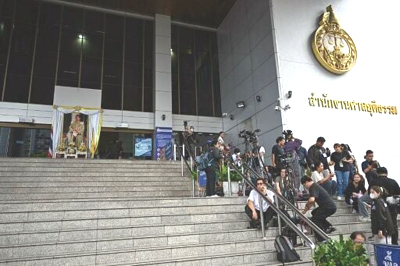
Former
Prime Minister Thaksin
Shinawatra avoided
reporters using a
side entrance rather
than the front entrance
of the Bangkok Criminal
Court on Tuesday July
1, 2025
|
|
From
News Reports:
Bangkok, July 4: Former Prime Minister
Thaksin Shinawatra appeared at the
Bangkok Criminal Court on Tuesday
to hear prosecution witnesses testimony
against the former Prime Minister
for alleged violation of the Lese
Majeste Law and the Computor Crime
Act allegedly committed in an interview
in South Korea in 2015, with defence
lawyer saying his client is personally
questioned prosecution witnesses,
reports Bangkok Post.
Defence lawyer, Winyat Chatmontree,
said he was unable to provide details
of court proceedings, saying ''the
court proceedings were closed to
the public.''
He said the court has instructed
the parties involved not to disclose
any details from the hearings, saying
''doing so could harm the case.''
Defence lawyer, Winyat Chatmontree,
said he could state the number of
witnesses but could not reveal their
identities, saying he could not
comment on the investigation into
the South Korea interview with former
Prime Minister Thaksin Shinawatra
in South Korea.''
''The Investigation into the interview
is included in the closed court
proceedings,'' he said.
Defence lawyer, Winyat Chatmontree,
said that three witnesses were examined
on Tuesday, four on Wednesday and
three on Thursday, saying witnesses
include a Thai speaking Korean interpreter
and a lawyer who was an important
witness, saying 'the translation
of Thaksin's interview in Seoul,
South Korea on May 21, 2015 was
incomplete.''
''There was one problematic English
word that led to the allegation
brought against Thaksin Shinawatra,''
he said.
The Office of the Attorney General
(OAG) prosecutors charged former
Prime Minister Thaksin Shinawatra
under Section 112 of the Criminal
Code 2007 for alleged violation
of the Lese Majeste Law and the
Computor Crime Act following a complaint
lodged by the Privy Council of 18
appointed advisors to the monarchy.
The Privy Council claimed that former
prime Minister Thaksin Shinawatra
had allegedly defamed the monarchy
in a foreign media interview in
Seoul, South Korea on May 21, 2015.
The Office of the Attorney-General
had received advice from the Royal
Thai Police (RTP) at the Technology
Crime Suppression Division on a
complaint from the Privy Council
that Thaksin Shinawatra had accused
the Privy Councillors of supporting
the 2014 coup that ousted the former
Prime Minister Yingluck Shinawatra,
who is Thaksin Shinawatra's younger
sister, in the media interview in
Seoul in South Korea on May 21,
2015.
In May 2016 the Department of Consular
Affairs director-general, Thongchai
Chasawat, issued an order to revoked
Thaksin Shinawatra's Thailand passport
claiming that former prime minister
Thaksin Shinawatra's interview in
Soeul in South Korea had undermined
"national security and dignity."
The
Southeast Asian Times
|
Thailand
Constitutional Court
suspends PM from duty
over phone conversation
with former Cambodia
PM
|
|
 |
|
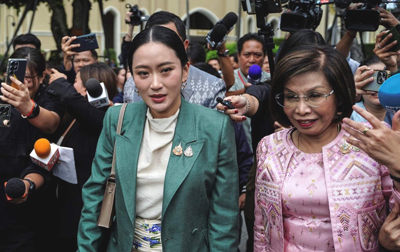
Thailand's
Constitutional Court
suspended Prime Minister
Paetongtarn Shinawatra,
left, from duty on
Tuesday July 1, 2025
over breach of ethical
standards in phone
conversation with
Cambodian Senate President
Hun Sen over Thailand
Cambodia border dispute
|
|
From
News Reports:s
Bangkok, July 3: Thailand’s
Constitutional Court suspended Prime
Minister Paetongtarn Shinawatra
from duty pending consideration
of the Prime Ministers phone conversation
with former Cambodia Prime Minister
Senate President Hun Sen, with nine
Consititutional Court judges unanimously
accepting a petition against Paetongtarn
Shinawatra continuing as Prime Minister,
reports the Bangkok Post.
The Constitutional Court suspended
Paetongtarn Shinawatra from duty
after a petition was submitted by
36 senators accusing the Prime Minister
of breaching ethical standards involved
in the Thailand Cambodia border
dispute.
Nine Constitutional Court judges
resolved unanimously to accept
the petition from the senators
against Paetongtarn Shinawatra
continuing as Prime Minister,
temporarily suspending Paetongtarn
Shinawatra from office by seven
votes to two.
The senators petitioned the Constitutional
Court to investigate a
The petition, initiated by 36
senators, asked the court to investigate
a phone conversation between Thailand
Prime Minister Paetongtarn Shinawatra
and Cambodian Senate President
Hun Sen on June 15.
The petitioners claim that Prime
Minister Paetongtarn Shinawatra
made derogatory remarks about
the Thailand Commander of the
Second Royal Thai Armed Forces
(RTARF) Chief of Defence Forces
of the (RTARF), General Songwit
Noonpackdee.
The petitioners claim that Prime
Minister Paetongtarn Shinawatra
branded the Thailand Commander of
the Second Royal Thai Armed Forces
(RTARF as an adversary.
''Prime Minister Paetongtarn Shinawatra
showed a submissive tone towards
Hun Sen by signalling a readiness
to comply with Cambodian Senate
President Hun Sen's demands over
the Thailand - Cambodia border,''
claim the Senators in the petition.
The Senators claim that Prime Minister
Paetongtarn Shinawatra lacks qualifications
and integrity under Setion 160 (40
and (5) of the Constitution, saying
''the Prime Minister lacked honesty
and engagement in conduct that constitutes
a grave breach of ethical standards.''
Paetongtarn Shinawatra said she
had phoned Cambodian Senate President
Hun Sen after the Constitutional
Court order to prevent more clashes
with Cambodia saying ''I was thinking
only about a way to prevent clashes
and casualties.''
'' I insist that I had no ill
intentions,'' she said.
"I apologise if the approach
I took was unsatisfactory,'' said
Paetongtarn Shinawatrath.
The
Southeast Asian Times
s
|
Thousands
demand Thailand's
PM resignation vowing
continuous street
protests in Bangkok
|
|
 |
|
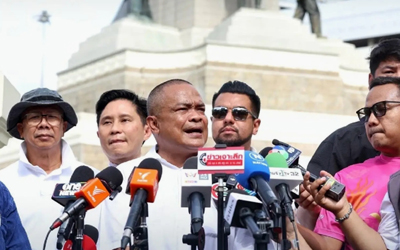
The
''United Power of
the Land to Protect
Sovereignty'' leader,
Jatuporn Prompan,
demands the resignation
of Thailand Prime
Minister Paetongtarn
Shinawatra, vowing
nonstop street protests
at Victory Monument
in Bangkok on Saturday
June 28, 2025
|
|
From
News Reports:
Bangkok, Wednesday July 2: Leader
of the ''United Power of the Land
to Protect Sovereignty,'' Jatuporn
Prompan, vowed continuous street
protests after thousands protested
at the Victory Monument in Bangkok
on Sunday demanding the resignation
of Prime Minister Paetongtarn Shinawatra,
saying ''the protest was not a call
for a military coup,'' reports the
Bankok Post
''The aim of the protest was to
defend Thailand sovereignty in a
peaceful way,'' he said.
The ''United Power of the Land to
Protect Sovereignty'' group leader,
Jatuporn Prompan, called on supporters
to prepare for street camps for
continuous protests, saying ''protesters
are demanding the resignation of
Prime Minister Paetongtarn Shinawatra.''
''Their message has grown louder
and their demands more direct,''
he said.
Jatuporn Prompan warned that the
protests are not short-term, instructing
supporters to prepare for a long-term
street camps, saying ''street protests
will remain until Prime Minister
Paetongtarn Shinawatra resigns.''
Jatuporn Prompan, claims that Prime
Minister Paetongtarn Shinawatra,
had compromised national sovereignty
in a conversation with former Cambodian
Prime Minister on June 15, saying
''Prime Minister Paetongtarn Shinawatra,
had opposed actions by the Commander
of the Second Royal Thai Armed Forces
(RTARF) Chief of Defence Forces
of the (RTARF), General Songwit
Noonpackdee, over the Thailand -
Cambodia border dispute.
Prime Minister Paetongtarn Shinawatra
had told former Cambodia Prime Minister,
Hun Sen, that she opposed the action
of the Thailand Commander of the
Second Royal Thai Armed Forces (RTARF)
over the Thailand - Cambodia border
clash that led to the death of a
Cambodia soldier on May 28.
''Even Cambodian do not trust this
Prime Minister.'' he said,
''Cambodia sends warriors,'' he
said, ''we send Girl Scouts.''
'United Power of the Land to Protect
Sovereignty'' leader, Jatuporn Prompan,
said the protest against Prime Minister
Paetongtarn Shinawatra that was
attended by thousands on Saturday
is a warning to the government,
saying ''the Thailand Cabinet is
not working.''
In November 2013 the United Nations
International Court of Justice (ICJ)
in the Hague, in an unanimous decision,
ruled that the immediate area surrounding
the 11th century Preah Vihear Hindu
temple on the Thailand - Cambodia
border belongs to Cambodia.
"Cambodia holds sovereignty
over the whole territory of the
promontory of Preah Vihear,"
said International Court of Justice,
Judge Peter Tomka after the court
decision.
The judge, one of seventeen, said
that as a consequence of the decision
Thailand was now under obligation
to withdraw Thailand military or
police forces or other guards or
keepers who were stationed in the
immediate area surrounding the temple.
The
Southeast Asian Times
|
Malaysia
and Indonesia reaffirm
commitment to two-state
solution to resolve
Israeli-Palestine
conflict
|
|
 |
|
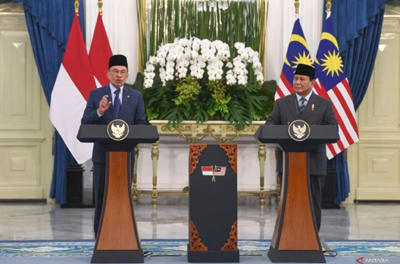
Malaysian
Prime Minister Anwar
Ibrahim, left, and
Indonesian President
Prabowo Subianto,
right, at the Merdeka
Palace in Jakarta
on Friday June 27,
2025
|
|
From
News Reports:
Jakarta, July1: Association of
Southeast Asian Nations (ASEAN)
members, Malaysia and Indonesia,
reaffirmed their shared commitment
to the two-state solution as the
most viable path to resolving
the Israeli–Palestinian conflict,
saying ''the two state solution
it the only route to a just and
lasting peace for Palestine,''
in Jakarta on Friday, reports
Antara.
"We continue to support Palestine's
independence,'' said Indonesia
President Prabowo Subianto and
Malaysia Prime Minister Anwar
Ibrahim in a joint statement.
''Only a two-state solution can
end this conflict," they
said.
Malaysia Prime Minister Anwar
Ibrahim said that both Indonesia
and Malaysia support a peaceful
resolution to the conflict in
Palestine, saying ''both Indonesia
and Malaysia share a common desire
for peace not just between Iran
and Israel but across the entire
Middle East.''
Indonesia President Prabowo Subianto
said that Malaysia and Indonesia
would continue to advocate for
a peaceful resolution by all parties,
saying Malaysia and Indonesia
welcome the ceasefire between
Israel and Iran.
''We hope this process can move
forward towards lasting peace,''
he said.
''Only a two-state solution can
bring an end to this conflict,''
he said.
Indonesia President Prabowo Subianto
said ''Indonesia and Malaysia
believe a global collective effort
is essential to promote a peaceful
resolution to the conflict, saying
''Indonesia would continue to
support Palestinian independence.''
In February 2025 the Association
of South East Asian Nations (ASEAN)
Malaysia chair for 2025, said that
Malaysia disagrees with the proposal
to resettle Palestinians from Gaza
following U.S president Donald Trump's
proposal to resettle two million
Palestinians from Gaza to neighbouring
countries, with Malaysia Foreign
Minister, Mat Hasan saying then,
''Malaysia strongly disagrees with
the proposal to resettle Palestinians
from Gaza.''
'We’re against the recommendation
as it is against all international
conventions, charters and treaties,''
he said in Parliament during question
time .
Malaysia Foreign Minister, Mat
Hasan, said that he had discussed
the proposal to remove Palestinians
from Gaza with ASEAN counterparts,
saying ''ASEAN counterparts also
disagree with the proposal.''
In January 2025 Indonesia called
for support for full membership
of Palestine in the United Nations
Security Council (UNSC) at the
19th Summit of the Non-aligned
Movement (NAM), titled "Deepening
Cooperation for Shared Global
Affluence." in Kampala, Uganda,
with Indonesia's Deputy Foreign
Minister saying "Indonesia
has consistently supported the
People of Palestine's struggle
for independence."
Indonesia Deputy Foreign Minister,
Pahala Nugraha Mansury, called
on the 121 Non-aligned Movement
(NAM) member states that comprise
of more than half of the world's
population " to support full
membership of Palestine in the
United Nations Security Council,
" saying "currently
five NAM members are serving as
Non-Permanent Members of the UN
Security Council, and it is anticipated
that they can articulate a joint
NAM position on Palestine."
Indonesia Deputy Foreign Minister,
Pahala Nugraha Mansury met with
the Foreign Ministers of Palestine
and South Africa saying "Indonesia
supports the Palestinian peoples
struggle to achieve a long-term
solution and independence."
"Indonesia also supports
South Africa's legal action against
Israel in the International Court
of Justice (ICJ)," said Indonesia
Deputy Foreign Minister, Pahala
Nugraha Mansury.
The
Southeast Asian Times
|
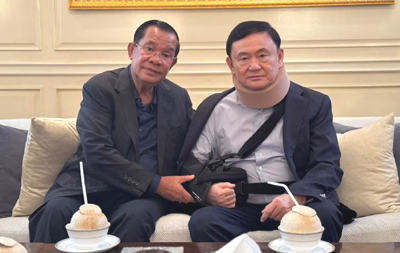
Cambodia
claims Thaksin Shinawatra
wore neck and arm
braces in Police General
Hospital to avoid
prison
|
|
 |
|
Cambodian
Senate President former
Prime Minister of
Cambodia, Hun Sen,
left, and former Prime
Minister of Thailand
Thaksin Shinawatra
in Bangkok on Friday
February 21, 2025
|
|
From
News Reports:
Bangkok, June 30: Cambodian Senate
President Hun Sen claims that former
Prime Minister of Thailand, Thaksin
Shinawatra, was not genuinely ill
during his visit to Bangkok in February
21, 2024, saying ''the former Prime
Minister had a neck and arm brace
merely for the sake of photographs,''
reports the Bangkok Post.
"I flew to Bangkok to visit
Thaksin, He was not ill at all,''
said Cambodian Senate President
Hun Sen.
''But when it came time to take
photos, Thaksin Shinawatra asked
for a neck brace and an arm brace
to appear unwell,'' he said.
He said that as soon as the photos
were taken, ''Thaksin Shinawatra,
removed the braces and went to
dine.''
''That's not illness that's theatre,''
he said.
He said that Thai people are suspicious,
saying ''I'm only confirming what
many have thought.''
''Both Thaksin and his daughter,
Paetongtarn, are acting in bad
faith,'' he said.
Cambodian Senate President Hun Sen
claims that Prime Minister Paetongtarn
Shinawatra was fully aware that
her father Thaksin Shinawatra was
not genuinely unwell, saying ''Prime
Minister Paetongtarn Shinawatra
took part in deceiving the Thailand
Constitutional Court.''
''Phnom Penh governor, Khuong Sreng,
was a witness to the staged illness
together with several Thais who
were present at the visit to Bangkok
on February 21, 2024,'' he said.
In January 2025 protesters led
by Jatuporn Prompan, Dr Warong
Dechgitvigrom, Jade Donavanik,
and Dr Tul Sittisomwong,
submitted a letter of complaint
to the Office of the Ombudsman
in Bangkok calling on Prime Minister
Paetongtarn Shinawatra to separate
her relationship with her father,
former Prime Minister Thaksin
Shinawatra, from the administration
of Thailand.
The letter of complaint protested
against the Department of Corrections
Thailand and the Police General
Hospital in Bangkok for not cooperating
with an investigation by the National
Anti-Corruption Commission (NACC)
and the Medical Council of Thailand
into Thaksin Shinawatra's stay at
the Police General Hospital in Bangkok
for one year after his return to
Thailand
Former Prime Minister, Thanksin
Shinawatra, faced Lese Majeste
Law and the Computor Crime Act
charges on his return to Thailand
from exile in Dubai and Hong Kong
in August 22, 2023 after fleeing
Thailand in 2008 to avoid trial
for nonfeasance and malfeasance
while holding the position of
Prime Minister.
Former Prime Minister Thaksin Shinawatra
was sentenced to eight years in
prison on his return to Thailand,
reduced to one year by a royal pardon
in honour of King Maha Vajiralongkorn's
birthday, following the election
of his daughter, Paetongtarn Shinawatra,,
as the 31st Prime Minister of Thailand
on August 16, 2024.
Inmates at the Police General Hospital
in Bangkok are legally permitted
to receive treatment outside prison
for 120 days but the Department
of Corrections Thailand allowed
Thaksin Shinawatra to stay at the
Police General Hospital for 180
days on his return to Thailand,
saying that conditions in the prison
could threaten his life.
Former Prime Minister Thaksin Shinawatra
paid all costs for his six-month
stay at the PoliceGeneral Hospital
in Bangkok, including a VIP room
on the hospital's 14th floor costing
8,500 baht a night.
'We are fully aware that Prime
Minister Paetongtarn Shinawatra
is Thaksin Shinawatra's daughter
but, as the leader of Thailand
she should prioritise the national
interest over family ties,'' said
the letter of complaint to the
Office of the Ombudsman
The
Southeast Asian Times
|
Former
ISIS terrorists renounce
terrorism pledging
allegiance to Indonesia
and loyality to Pancasila
|
|
 |
|
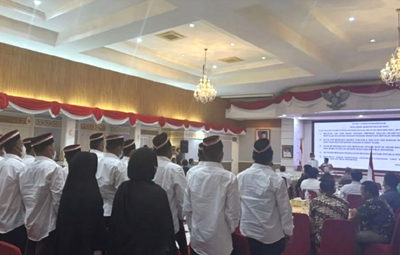
Thirty-four
former members of
the Anshor Daulah
(AD) terror group
pledged allegiance
to the Republic of
Indonesia at a ceremony
held at the Riau Governor’s
official residence
in Pekanbaru, Riau,
on Friday June 27,
2025
|
|
From
News Reports:
Jakarta, June 29: Thirty-four former
members of the terror group Anshor
Daulah (AD) that is affiliated with
the terror group Islamic State of
Iraq and Syria (ISIS) renounced
terrorism and pledged their allegiance
to the Unitary State of the Republic
of Indonesia and loyality to Pancasila
state ideology at the Balai Serindit
office of the Riau Provincial Government
complex in Pekanbaru on Friday,
with Indonesian National Police,
Anti-Terror Squad Densus 88, saying
''the pledge marks a complete break
from their past as members of the
terror organization,'' reports Antara.
''Their renouncement and subsequent
loyalty pledge is part of their
recovery and transformation to once
again stand on their own feet for
the Republic of Indonesia and its
ideology,'' said Indonesian National
Police, Anti-Terror Squad Densus
88, Brigadier General I Made Astawa.
''Terrorism manifests not only in
physical violence but also in the
silent indoctrination of ideologies
that justify hatred and terror in
the name of religion,'' he said.
Governor of Riau Province Abdul
Wahid, commended the Ministry of
Law, Directorate General of Corrections
(DGC) the National Counter-Terrorism
Agency (BNPT), the Indonesian National
Military (TNI), Indonesian National
Police, Anti-Terror Squad Densus
88, and the State Intelligence Agency
(BIN), for their involved in the
deradicalization efforts of the
thirty-four former members of the
terror group Anshor Daulah (AD)
reintergration into society.
Governor of Riau Province Abdul
Wahid said that Riau province is
proud of the 34 individuals who
declared their loyality to Indonesia,
saying he recognised the determination
it takes to renounce terrorism.
In January 2022 the Directorate
General of Corrections (DGC), Rika
Aprianti, said after 122 convicted
Jemaah Islamiyah (JL)
terrorists incarcerated in Indonesian
prisons swore allegiance to the
Unitary State of the Republic of
Indonesia and loyality to Pancasila
state ideology under the deradicalizing
of terrorism program, ''the deradicalizing
of terrorism program has been a
success.''
The deradicalisation of terrorism
program teaches the convicted terrorists
to understand that Pancasila ideology
is not just the foundation of the
nation but also acts as a national
ideology that unites the people
of Indonesia,'' said the Directorate
General of Corrections (DGC), Rika
Aprianti.
"In their pledge to Pancasila
ideology, convicted Jemaah Islamiyah
(JI) terrorists swear loyalty to
Pancasila state ideology and the
1945 Constitution and commit to
protecting the nation from all acts
of terrorism that could destroy
Indonesia's unity," she said.
In January 2021 Muslim cleric Abu
Bakar Ba`asyir, 81, the spiritual
leader of Al-Qaeda-affiliate Jemaah
Islamiyah (JI), who was found guilty
by the South Jakarta District Court
in 2011 for organising acts of terror,
including the Bali bombings was
released from Gunung Sindur prison
in Bogor, West Java Province after
pledging loyalty to the Unitary
State of the Republic of Indonesia
and to Pancasila state ideology.
Muslim cleric Abu Bakar Ba`asyir's
arrest in 2012 was the third effort
since 2000 to have the spiritual
leader of Al-Qaeda-affiliate Jemaah
Islamiyah (JI) convicted for terrorism.
He served almost 26 months in jail
before he won his appeal in 2006
against his conviction for conspiracy
following the Bali bombings of 2002
in which more than 200 people, most
of them Australians, were killed.
The
Southeast Asian Times
|
Beijing
calls on Singapore
to join China against
United States 'hegemony'
|
|
 |
|
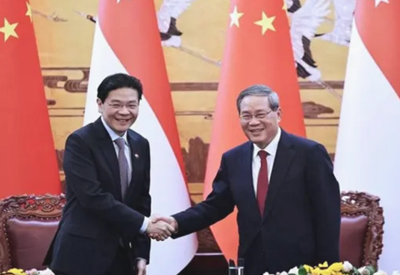
Singapore
Prime Minister Lawrence
Wong, left, and China
Premier Li Qiang,
right, in Bejing on
Monday June 23, 2025
|
|
From News
Reports:
Singapore, June 28: China called
on Association of South East Asian
Nation (ASEAN) member, Singapore,
to join China against United States
hegemony and trade protectionism
during Singapore Prime Minister
Lawrence Wong five day visit to
Beijing, with the Premier of China,
Xi Jinping, saying ''stand on
the right side of history and
on the side of fairness and justice,''
reports the Agence France Presse.
''The world cannot return to United
States hegemony or be dragged
back to the law of the jungle,''
Premier of China, Xi Jinping said
at the Great Hall of the People
on Monday.
Singapore Prime Minister Lawrence
Wong said that his visit to China
was the first visit to a country
outside the Association of South
East Asian Nations (ASEAN) since
he succeeded Singapore Prime Minister
Lee Hsien in May 2024.
''I believed the Singapore-China
relationship is more important
than before at this time of global
turbulence and uncertainty.''
he said.
''We can work together to establish
closer ties and continue to strengthen
multilateralism and the rules-based
global order for the benefit of
all countries,'' he said.
Singapore Prime Minister Lawrence
Wong and Premier of China, Xi
Jinping agreed ''on the importance
of maintaining open and inclusive
trade as a key driver of economic
growth and stability and reaffirmed
support for a rules-based multilateral
trading system.''
In April 2025 the Dean of school
of public policy at the China
University of Hong Kong, Zheng
Yongnian, warned that ''the United
States would not assist the Association
of South East Asian Nations (ASEAN)
in economic development' at the
3rd China-Asean Economic Relations
Seminar, titled "High-Level
Opening-Up and China-ASEAN Common
Market."
''Some ASEAN countries would face
stalled economic development and
isolation by China if they choose
to align more closely with Washington
in the trade war,'' he said.
He said that China was better
placed to help the 10 ASEAN member
nations in realising its economic
goals, saying ''China has called
on ASEAN countries to establishment
a China-ASEAN common market to
promote trade stability and development
in South East Asia amid the United
States tariffs.''
He said that ASEAN member nations
Vietnam, Malaysia and Thailand
''face a precarious balancing
act as they negotiate trade terms
with the new President Donald
Trump administration, saying ''ASEAN
is China's largest trading partner.''
''Either scale back lucrative
economic ties with China or prepare
for punishing United States tariffs
on critical exports,'' he said.
He said that not all countries
will be pivoting towards Washington
as United States tariffs cause
worldwide economic uncertainty,
saying "more nations will
instead choose to distance themselves
from the United States.''
The
Southeast Asian Times
|
Vietnam
National Assembly
abolishes death penalty
in eight out of 18
criminal offences
|
|
 |
|
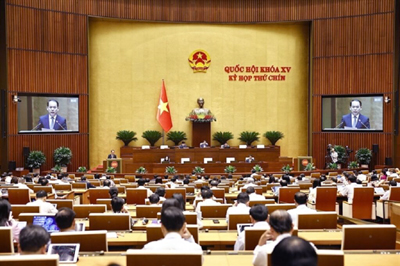
Vietnam's
National Assembly
legislators abolished
the death penalty
for eight criminal
offences including
embezzlement of state
property and bribery
of state officials
at the 9th session
of the 15th National
Assembly in Hanoi
from May 5 to June
30
|
|
From
News Reports:
Hanoi, June 27: Vietnam's National
Assembly legislators abolished
the death penalty for eight criminal
offences including embezzlement
of state property and bribery
of state officials, leaving ten
criminal offences liable for the
death penalty including treason
and terrorism at the 9th session
of the 15th National Assembly
in Hanoi from May 5 to June 30,
reports the Vietnam News Agency.
''The Communist Party of Vietnam
plans to replace capital punishment
with life imprisonment without
parole in eight out of 18 offences,''
said Minister of the Political
Bureau also the Minister of Public
Security of the Communist Party
of Vietnam (CPV), Senior Lt. Gen.
Luong Tam Quang, after the draft
law to amend the Penal Code was
submitted to the National Assembly
on May 20.
The death penalty was abolished
for eight criminal offences including
embezzlement of state property,
bribery of state officials, vandalization
of state property, the manufacture
of counterfeit medicine, espionage,
drug trafficking, sabotage, and
acts aimed at overthrowing the Communist
Party of Vietnam (CPV) with the
National Assembly legislators voting
439 for the passing of the amendments
to the Criminal code with 429 against.
''The amendments to the 2017 Penal
Code are no longer aligned with
Vietnam's socio-economic realities
or the evolving nature of crime,''
said Senior Lt. Gen. Luong Tam
Quang.
He said that the introduction
of life imprisonment without parole
would maintain public safety,
saying ''the offender would be
isolated from society.''
Senior Lt. Gen. Luong Tam Quang
said the draft law to amend the
2017 Penal Code that was submitted
on May 20 ''exempts death row
inmates from execution in specific
humanitarian cases.''
''An individual with terminal-stage
cancer or those living with AIDS
are exempt from the death penalty.''
He said that courts have avoided
handing down the death sentence
for subversion and the production
of counterfeit medicine, saying
''the death penalty for embezzlement
of state property and bribery
of state officials have been used
sparingly.''
Ten criminal offences remain liable
for the death penalty including
murder, treason, terrorism, sexual
abuse of children, drug-related
offenses, crimes against national
security, destruction of national
security facilities, threatening
peace, war crimes, and armed robbery.
The
Southeast Asian Times
|
'Dr
Air' prescribes drugs
in names of deceased
patients at Bangkok
Police General Hospital
|
|
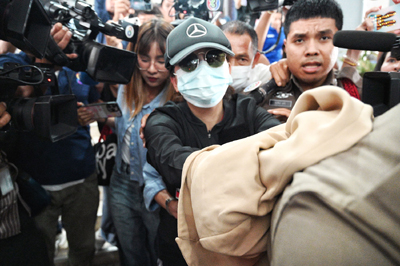 |
| Pol
Col Dr Anchulee Theerawongpaisal,
also known as ''Dr Air,''
psychiatrist at the
Police General Hospital
in Pathum Wan was arrested
for misusing her credential
to procure the drug
alprazolam and other
psychotropic drugs in
Bangkok on Wednesday
June 11, 2025
|
|
From
News Reports:
Bangkok, June 26: Thailand's Food
and Drug Administration (FDA) and
the Ministry of Public Health (MOPH)
have submitted evidence against
senior psychiatrist Pol Col Dr Anchulee
Theerawongpaisal and seven doctors
at the Bangkok Police General Hospital
to the Provincial Police Region
1 for their alleged involvement
in the prescription of drugs in
the name of deceased patients, reports
the Bangkok Post.
Pol Col Dr Anchulee Theerawongpaisal,
also known as ''Dr Air,'' who is
a psychiatrist at the Police General
Hospital in Pathum Wan District,
Bangkok, is in Royal Thai Police
(RTP) custody after her arrest on
June 11 for misusing her credentials
to procure the drug alprazolam and
other psychotropic drugs from the
Thai Food and Drug Administration
(FDA) that were proscribed in the
names of deceased patients.
The Food and Drug Administration
(FDA) Narcotics Control Division
and Legal Affairs, director, Chatchai
Panichsupphaporn, and Ministry of
Public Health (MOPH) assistant Dr
Thanakrit Jitareerat have submitted
evidence to the Provincial Police
Region 1 in Pathum Wan, Bangkok
that Dr Anchulee, also known as
"Dr Air" has ordered Baht15
million (US$460,000) worth of the
drug Alprazolam from the Food and
Drug Administration (FDA) since
2022.
Ministry of Public Health (MOPH)
assistant Dr Thanakrit Jitareerat
said that the evidence against senior
psychiatrist Pol Col Dr Anchulee
Theerawongpaisal and seven doctors
includes their alleged involvement
in the misuse of 370 names of deceased
patients to prescribe drugs for
illegal distribution.
He said that an inspection by the
Food and Drug Administration (FDA)
Narcotics Control Division and Legal
Affairs, of 13 clinics found that
nine were allegedly involvement
in the prescription of drugs in
the names of deceased patients..
''Seven doctors including senior
psychiatrist Pol Col Dr Anchulee
Theerawongpaisal were implicated
in the procurement of the drug alprazolam
and other psychotropic drug.'' he
said.
He said an investigation into the
illegal use of the identities of
deceased patients to prescribe drugs
for distribution revealed that six
of the seven doctors are not affiliated
with public hospital clinics, saying
''the six doctors work in private
clinics.''
Pathum Police General Hospital psychiatrist
Pol Col Dr Anchulee Theerawongpaisal
also known as ''Dr Air'' was arrested
on June 11, after the Royal Thai
Police (RTP) found large amounts
of the drug Alprazolam stored at
the Royal Thai Police (RTP) barracks.
Lawyer, Nitisak Meekhuad, for Pol
Col Dr Anchulee Theerawongpaisal
said that his client had declared
her intention not to apply for bail.
Pol Col Dr Anchulee Theerawongpaisal
is in detention at the Central Women’s
Correctional Institution.
The
Southeast Asian Times
|
New
extradition law to
test Singapore's return
of fugitive to Indonesian
to face e-ID embezzlement
charges
|
|
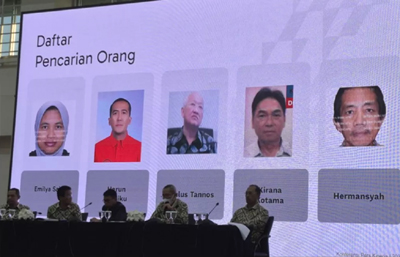 |
| Fugitive
Paulus Tannos, 70, also
known as Tjhin Thian
Po, centre, is wanted
by the Indonesian Corruption
Eradication Commission
(KPK) for his alleged
involvement in the embezzlement
of funds from the State
Printing Company of
the Republic of Indonesia
(PNRI) from 2011 to
2013 |
|
From
News Reports:
Singapore, June 25: The new extradition
law between Singapore and Indonesia
that came into effective in 2024
will be tested in the Singapore
State Courts with the arrest of
Indonesian fugitive Paulus Tannos,
70, by the Singapore Corrupt Practices
Investigation Bureau (CPIB) on January
17, after fugitive Paulus Tannos,
70, also known as Tjhin Thian Po,
has repeatedly declined to surrender
to Indonesia, with the Singapore
State Court saying ''the hearing
does not have to determine guilt,''
reports Straits Times.
The three day Singapore State Court
hearing that began on Monday will
decide if the evidence that includes
affidavits submitted by the Indonesian
Corruption Eradication Commission
(KPK) is sufficient to return fugitive
Paulus Tannos, 70, also known as
Tjhin Thian Po, to Indonesia.
Fugitive Paulus Tannos, 70, also
known as Tjhin Thian Po, who has
resided in Singapore since 2017,
holds a diplomatic passport from
Guinea-Bissau in West Africa, but
remains an Indonesian citizen despite
his attempt to renounce Indonesian
citizenship.
Fugitive Paulus Tannos, 70, also
known as Tjhin Thian Po, is wanted
by the Indonesian Corruption Eradication
Commission (KPK) for his alleged
involvement in the embezzlement
of funds from the State Printing
Company of the Republic of Indonesia
(PNRI) from 2011 to 2013.
Paulus Tannos, 70, also known as
Tjhin Thian Po, former president
and director of the e-ID electronic
identity card printing company,
PT Sandipala Arthaputra, is wanted
for his alleged involved in the
embezzlement of funds from the State
Printing Company of the Republic
of Indonesia (PNRI) that allegedly
caused Rp 2.3 trillion (US$161 million)
loss to the state.
In April 2018 the Corruption Eradication
Commission (KPK) court in Jakarta
sentenced the former House of Representatives
(DPR) speaker Setya Novanto, to
15 years in prison for his involvement
in the procurement of e-ID cards
after finding that there was sufficient
preliminary evidence to charge the
former speaker with corruption.
The Indonesia Corruption Eradication
Commission (KPK) court found that
House of Representatives (DPR) speaker
Setya Novanto had a key role in
setting the budget for the procurement
of the e-ID cards electronic identity
cards between 2011 and 2012.
The budget was split with 51 percent
or Rp2.662 trillion used for the
procurement of the e-ID card and
the balance was embezzled and divided
between senior officials of the
Home Affairs Ministry and lawmakers
of the Commission II of House of
Representatives.
The
Southeast Asian Times
|
Cambodia
claims Thailand led
an army of cyclists
to disputed border
temple without notice
|
|
 |
| Cambodia
claims Thailand has
violated the 2013 International
Court of Justice (ICJ)
decision after the Royal
Thai Armed Forces (RTARF)
led about 150 cyclists
to the disputed Ta Moan
Thom Temple without
prior notification on
Sunday June 22, 2025 |
|
From News Reports:
Phnom Penh, June 24: Cambodia's
Ministry of National Defence claims
Thailand violated the 2013 International
Court of Justice (ICJ) decision
after the Royal Thai Armed Forces
(RTARF) led about 150 cyclists to
the disputed Ta Moan Thom Temple
on Sunday without prior notification,
with the Royal Thai Armed Forces
saying ''Thailand informed Cambodia
of the visit to the temple on Saturday,''
reports the Khmer Times.
Cambodia's Ministry of National
Defence, Deputy Prime Minister,
Minister of National Defence, Gen.
Tea Seiha, claims that ''Thailand
has again violated its agreement
with Cambodia by not giving prior
notification of entry into the Temple,''
He said that Royal Thai Armed Forces
(RTARF) entry to the temple without
prior notification is a clear violation
of the 2013 International Court
of Justice (ICJ) decision that obliged
Thailand to withdraw any military
or police from the Ta Moan Thom
temple.
''The Thailand military led about
150 Thailand cyclists into the grounds
of the Ta Moan Thom Temple at about
7.30.am without prior notice to
the Royal Cambodian Armed Forces,''
he said.
He said that the Royal Cambodian
Armed Forces reminded the Royal
Thai Armed Forces (RTARF) of 2013
International Court of Justice (ICJ)
decision.
''The Thailand cyclists then left
the Ta Moan Thom Temple without
incident,'' he said.
Royal Thai Armed Forces (RTARF)
spokesperson, Maj Gen Winthai Suvaree,
denied the Royal Cambodian Armed
Forces claim that Cambodia had informed
the Royal Thai Armed Forces (RTARF)
of the cyclists visit to the Ta
Muen Thom temple in Surin.
''The visit to the Ta Muen Thom
temple was part of a tourism event
organised by the Surin Provincial
Office of Tourism and Sports under
the ''Cycle to Two Sanctuaries,
Taste Durian of the Elephant Town
Phanom Dong Rak 2025 campaign.''
He said that the Royal Thai Armed
Forces (RTARF) had informed the
Royal Cambodian Armed Forces on
June 21 that the cyclists would
arrive at the Ta Muen Thom temple
on June 22, saying ''about 150 cyclists
left Phanom Dong Rak District and
as planned arrived at the Temple
at 7.30am.
In November 2013 the United Nations
International Court of Justice (ICJ)
in the Hague, in an unanimous decision,
ruled that the immediate area surrounding
the 11th century Preah Vihear Hindu
temple on the Thailand Cambodia
border including the Ta Muen Thom
temple in Surin belongs to Cambodia.
"Cambodia holds sovereignty
over the whole territory of the
promontory of Preah Vihear,"
said International Court of Justice,
Judge Peter Tomka at the court decision.
The judge, one of seventeen, said
that as a consequence of the decision
Thailand was now under obligation
to withdraw Thailand military or
police forces or other guards or
keepers who were stationed in the
immediate area surrounding the temple.
The
Southeast Asian Times
|
Indonesia
ASEAN member reinforces
non-alignment in foreign
policy with exchange
on MoU's with Russia
|
|
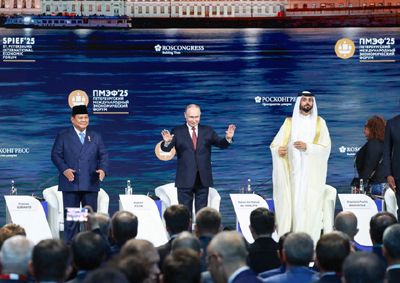 |
| Indonesian
President Prabowo Subianto,
left, Russia's President
Vladimir Putin, centre,
Bahrain's National Security
Advisor Sheikh Nasser
bin Hamad Al Khalifa,
right, at the International
Economic Forum (SPIEF)
attended by more than
21,000 participants
from 136 countries in
St. Petersburg, Russia
on Friday, June 20,
2025 |
|
From
News Reports:
Indonesia, June 23: Association
of South East Asian Nations (ASEAN)
member, Indonesia's President Prabowo
Subianto, exchanged Memorandum of
Understanding's (MoU's) on the ''Strategic
Partnership Declaration'' with Russian
President Vladimir Putin at the
International Economic Forum (SPIEF)
in St. Petersburg on Thursday, with
President Prabowo Subianto reinforcing
Indonesia's position of non-alignment
in foreign policy, reports Jakarta
Post.
Indonesia's President Prabowo Subianto
and Russia's President Vladimir
Putin exchanged Memorandum of Understanding's
(MoU's) on cooperation between the
Indonesian Investment Management
Agency for Renewable Energy Anagata
Nusantara (Danantara) and the Russian
Joint Stock Company Management company
of Russian Direct Investment Fund
(RDIF) with Indonesia President
Prabowo Subianto saying ''the age
of a multipolar world was emerging.''
''Russia and China have proven themselves
as leaders that do not have double
standards and that defend the downtrodden
and the oppressed,'' said Indonesia
President Prabowo Subianto at the
opening of the International Economic
Forum (SPIEF) in Saint Petersburg
on Thursday.
''Following the most powerful is
a mistake,'' he said
Indonesia is a member of the ASEAN
10 member nations, a member nation
of the 121 Non-aligned Movement
(NAM) nations and a new partner
in the Brazil, Russia, India, China
and South Africa (BRICS) with thirteen
nations including ASEAN members
nations Thailand, Indonesia, and
Vietnam joining BRICS on January
1.
''Jakarta will go ahead with its
economic ambitions without following
the philosophies of the biggest
and most powerful power in the world.''
Indonesian President Prabowo Subianto
and Russian President Vladimir Putin
exchanged four Memorandum of Understanding's
(MoU) at the International Economic
Forum (SPIEF) including between
the Indonesian Ministry of Higher
Education, Science and Technology
and the Russian Ministry of Science
and Higher Education at the International
Economic Forum (SPIEF) in St. Petersburg
on Friday.
A Memorandum of Understanding (MoU)
was also exchanged between the Indonesian
and Russian transport ministries.
The Indonesian Ministry of Communication
and Digital and the Russian Ministry
of Digital Development, Communications,
and Mass Media also exchanged a
Memorandum of Understanding (MoU).
The
Southeast Asian Times
|
Thailand
military calls for
meeting of Thailand
and Cambodia's regional
commanders to resolve
border conflict
|
|
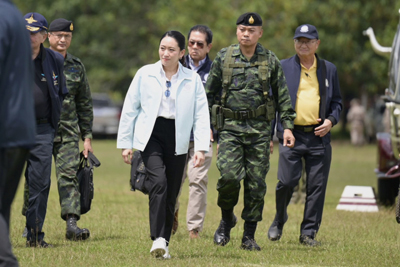 |
| Thailand
Prime Minister, Paetongtarn
Shinawatra, centre,
Commander Lt Gen Boonsin
Padklang, second right,
arrive by helicopter
at Nam Yuen district
in Ubon Ratchathani
Province on the Thailand
Cambodia border on Friday
June 20, 2025 |
|
From
News Reports:
Bangkok, June 22: The Royal Thai
Armed Forces (RTARF) called for
a meeting of the Thailand and Cambodian
regional military commanders, advising
Thailand Prime Minister Paetongtarn
Shinawatra to support the national
interest with a Morality Policy
to resolve the Thailand - Cambodia
border dispute,'' reports the Bangkok
Post.
Commander of the Second Army Area
of the Royal Thailand Armed Forces,
Lieutenant General Boonsin Padklang
called on Thailand Prime Minister
Paetongtarn Shinawatra ''to support
the national interest with a Morality
Policy to resolve the border dispute
with Cambodia after Prime Minister
Paetongtarn Shinawatra had referred
to the Royal Thai Armed Forces (RTARF)
as the ''opposition'' and referred
to the former Cambodia Prime Minister
Hun Sen as ''uncle.''
Thailand Prime Minister Paetongtarn
Shinawatra was accused of compromising
her position as Prime Minister
and damaging Thailand national
interest in a telephone conversation
with former Prime Minister of
Cambodia Hun Sen on June 15.
Commander of the Second Army Area
of the Royal Thailand Armed Forces,
Lt., Gen., Boonsin Padklang called
on the Thailand Prime Minister ''to
establish an experienced team of
advisors to aid her to support the
national interest with a Morality
Policy to resolve the border dispute
in order to rebuild international
confidence in Thailand.''
He said the Prime Minister should
resolve the dispute on the Thailand
Cambodia border with a Morality
Policy, saying he stood ready
to support a moral policy that
fully benefits the national interest.
Lt., Gen., Boonsin who is responsible
for security along the Thailand
- Cambodia border said border checkpoints
that were closed after the border
clash that killed a Thailand soldier
on May 28, ''will not be fully operational
until Thailand and Cambodia hold
a Regional Border Committee (RBC)
meeting.
He said Thailand has called for
a Regional Border Committee (RBC)
meeting that is chaired by Thailand
and Cambodian regional military
commanders, saying ''Cambodia
has yet to respond.''
''The Regional Border Committee
(RBC) meeting is vital if Thailand
and Cambodia are to end the deployment
of military along the border,''
he said.
Thailand rejected the Cambodia's
proposal for the Thailand- Cambodia
border dispute to be settled by
the International Court of Justice
(ICJ) in The Hague at the Joint
Boundary Commission (JBC) meeting
that was held in Phnom Penh on
Saturday June 14.
Cambodia Senate President, Hun
Sen, said ahead of the Joint Boundary
Commission (JBC) ''the dispute
will clearly remain unresolved
into the next century through
the existing Joint Boundary Commission
(JBC) mechanism.''
Cambodia Senate President Hun Manet
said that Cambodia will ask for
the International Court of Justice
(ICJ) in The Hague for intervention
with or without Thailand’s
participation, saying ''Cambodia
will unilaterally submit a complaint
to the International Court of Justice
(ICJ) in the four disputed areas,
Ta Moan Thom, Ta Moan Toch, Ta Krabey,
and Mom Tei.''
In November 2013 the United Nations
International Court of Justice
(ICJ) in the Hague, in an unanimous
decision, ruled that the immediate
area surrounding the 11th century
Preah Vihear Hindu temple on the
Thailand Cambodia border belongs
to Cambodia.
"Cambodia holds sovereignty
over the whole territory of the
promontory of Preah Vihear,"
said International Court of Justice,
Judge Peter Tomka after the court
decision.
The judge, one of seventeen, said
that as a consequence of the decision
Thailand was now under obligation
to withdraw Thailand military
or police forces or other guards
or keepers who were stationed
in the immediate area surrounding
the temple.
The
Southeast Asian Times
|
Thailand
royalists demand resignation
of PM for damaging
Thailand national
security by kowtowing
to Cambodia
|
|
 |
| The
Network of Students
and People for Reform
of Thailand (NSPRT)
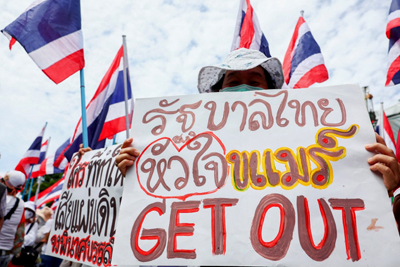
royal supporters hold
placard saying ''Thai
government with Khmer
heart Get Out'' at Government
House in Bangkok Post
on Monday June 16, 2025 |
|
From
News Reports:
Bangkok, June 21: Thailand's royalists
demanded the resignation of Prime
Minister Paetongtarn Shinawatra
at a Government House protest on
Monday, accusing the Prime Minister
of ''compromising her position as
prime minister and damaging Thailand
national security by kowtowing to
Hun Sen,'' in a leaked audio of
a telephone conversation between
Prime Minister Paetongtarn Shinawatra
and Cambodia Prime Minister Hun
Sen on June 15, reports Bangkok
Post.
The Network of Students and People
for Reform of Thailand (NSPRT) held
placards saying ''Thai government
with Khmer heart Get Out'' in reference
to the alleged conciliatory tone
used by Prime Minister Paetongtarn
Shinawatra towards former Cambodia
Prime Minister Hun Sen in a telephone
conversation over the Thailand -
Cambodia border dispute.
Chulalongkorn University professor
of political science, Thitinan Pongsudhirak,
said that Thailand Prime Minister
Paetongtarn Shinawatra has compromised
her position as Prime Minister and
damaged Thailand national interest
in her telephone conversation with
former Prime Minister of Cambodia
Hun Sen saying ''Prime Minister
Paetongtarn Shinawatra referred
to the commander of the Second Royal
Thai Armed Forces (RTARF) Area as
the 'opposite side'.
He said that Prime Minister Paetongtarn
Shinawatra had asked former Cambodia
Prime Minister Hun Sen to disregard
the actions of the Thailand commander
of the Second Royal Thai Armed Forces
(RTARF) Area following the Thailand
Cambodia border clash that led to
the death of a Cambodia soldier
on May 28.
Chulalongkorn University professor
of political science, Thitinan Pongsudhirak,
claims that ''Prime Minister Paetongtarn
Shinawatra's exit is a matter of
time,'' saying ''she could be liable
to further charges.''
Thailand Prime Minister Paetongtarn
Shinawatra, who reportedly referred
to former Cambodian Prime Minister
Hun Sen as ''uncle'' during the
17 minute telephone conversation
on June 15 over the border dispute,
was reportedly critical of the Commander
of the Second Army Area of the Royal
Thailand Armed Forces, Lieutenant
General Boonsin Padklang.
Commander of the Second Army Area
of the Royal Thailand Armed Forces,
Lieutenant General Boonsin Padklang
had reportedly
proposed to close the Thailand Cambodia
border after the border clash that
killed a Thailand soldier on May
28.
Thailand Prime Minister Paetongtarn
Shinawatra had reportedly told former
Cambodia Prime Minister Hun Sen
during the telephone conversation
that she was under domestic pressure
from opposition political parties.
Thailand Prime Minister Paetongtarn
Shinawatra urged former Cambodia
Prime Minister Hun Sen not to listen
to the ''opposite side,'' referring
to Commander of the Second Army
Area of the Royal Thailand Armed
Forces, Lieutenant General Boonsin
Padklang in the proposed decision
to close the border.
The
Southeast Asian Times
|
Three
Australians charged
with fatal shooting
of Australians in
Bali villa
|
|
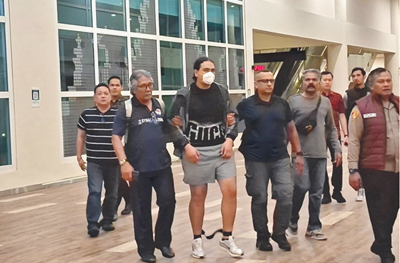 |
| Australian,
Coskun Mevlut, 23, centre,
arrested at Singapore
Changi airport on Monday
June 16, 2025 for the
fatal shooting of Australian
Zivan Radmanovic, 32,
in Bali |
|
From News Reports:
Bali, Friday 20: The Indonesian
National Police charged three Australian
males with the murder of Australian
Zivan Radmanovic, 32, who was shot
dead in Bali on Saturdayi, with
Bali Regional Police Chief Inspector
General Daniel Adityajaya, saying
''police allege the three men were
directly involved in executing and
preparing for the fatal shooting,''
reports Reuters.
The three Australian men, Darcy
Francesco Jenson, 37, Tupou Pasa
Midolmore, 37, and Coskun Mevlut,
23, who face charges of premeditated
murder that carries a death sentence
in Indonesia are also charged with
causing serious injury to Australian,
Sanar Ghanim, 35, in the fatal shooting
at the Canbbu Beach villa in Kuta
Utara, Badung, Bali on Saturday.
Australian, Darcy Francesco Jenson,
37, was arrested on charges of premeditated
murder at the Soekarno-Hatta Airport
in Jakarta on Monday .as he allegedly
attempted to flee Indonesia.
Tupou Pasa Midolmore, 37 was arrested
on charges of premeditated murder
on his arrival at Melbourne airport
by Australian Federal Police on
Monday after fleeing Indonesia.
Coskun Mevlut, 23, was arrested
on charges of premeditated murder
on arrival in Singapore Changi airport
after fleeing Indonesia on Monday.
Bali Regional Police Chief Inspector
General Daniel Adityajaya said the
three Australians who had fled Bali
on Monday were returned to Bali
on Tuesday night, saying ''all three
have been charged with premediates
murder.''
Witnesses at the Canbbu Beach villa
told the Bali Regional Police that
two gunmen arrived at the villa
in Kuta Utara, Badung, Bali on a
scooter at about midnight on Saturday.
Bali Regional Police said that 17
bullet casings and two intact bullets
were found in the bathroom of the
Canbbu Beach villa where Australian
Zivan Radmanovic, 32, was shot dead
on Saturday.
Gourdeas Jazmyn, wife of Australian
Zivan Radmanovic, 32, told the Bali
Regional Police that she awoke suddenly
when she heard her husband screaming,
saying ''I hid under a blanket when
I heard gunshots.''
''I later found my husband's body
and saw that Sanar Ghanim was injured,''
she said.
The Bali Regional Police said that
wife of Australian, Sanar Ghanim,
35, who was found seriously injured
at the Canbbu Beach villa has testified
to seeing the attackers who shot
her husband leaving him seriously
injured.
Bali Regional Police Chief Inspector
General Daniel Adityajaya said that
a 9mm gun was seized at the Canbbu
Beach villa, saying ''two vehicles
and a motorbike that were used to
flee the scene of the crime have
also been seized.''
The Bali Regional Police have not
given a motive for the crime, with
Chief Inspector General Daniel Adityajaya
saying ''the investigation continues.''
''A further suspect could be identified
as the plot's mastermind,'' he said.
The
Southeast Asian Times
|
Administrators
of East Java Social
media group arrested
for facilitating homosexual
in-person meetings
|
|
 |
|
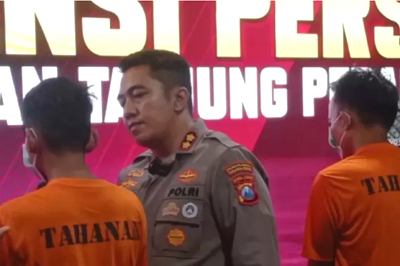
Administrators
of the social media
group titled "Gay
Tuban Lamongan Bojonegoro"
identified as MFK,
24, and GR, 36, accused
of facilitating homosexual
in-person meetings
by Police Superintendent,
Wahyu Hidayat, for
Lamongan Regency,
Surabaya, East Java
on Monday June 16,
2025
|
|
From
News Reports:
Jakarta, June 19: Indonesia National
Police, in Lamongan Regency, Surabaya,
East Java have arrested two administrators
of the social media group titled
"Gay Tuban Lamongan Bojonegoro"
accusing the males identified
as MFK, 24, and GR, 36, of facilitating
homosexual in-person meetings,
with Police Superintendent of
the East Java Regional Police,
Wahyu Hidayat, saying ''the arrests
follow a public complaint and
subsequent investigation by the
Directorate of Cyber Investigation
of the East Java Regional Police,''
reports Jakarta Globe.
Police Superintendent of the East
Java Regional Police, Wahyu Hidayat,
said the ''Gay Tuban Lamongan Bojonegoro"
social media group allowed its 4,500
members to share content related
to homosexual activities including
photos and videos, saying ''the
contents were shared to promote
same-sex interactions between men.''
''The Directorate of Cyber Investigation
of the East Java Regional Police
conducted profiling and identified
the administrators of the social
media group titled "Gay Tuban
Lamongan Bojonegoro,'' he said.
The administrators of the ''Gay
Tuban Lamongan Bojonegoro"
social media group identified
as MFK, 24, and GR, 36 were arrested
under Indonesia's Electronic Information
and Transactions (ITE) Law and
the Pornography Law, with MFK,
24, admitting to creating and
managing the social media group.
MFK, 24, claimed that the 'Gay
Tuban Lamongan Bojonegoro"
social media group ''was meant
for enjoyment,'' saying he did
not profit financially from his
role as administrator of the social
media group.
He said he occasionally received
cigarettes as a token of appreciation
when facilitating homosexual in-person
meetings between members of the
'Gay Tuban Lamongan Bojonegoro"
social media group.
"There was no material gain,
just cigarettes,'' he said.
He claimed that all members of the
Gay Tuban Lamongan Bojonegoro"
social media group ''joined voluntarily
and that homosexual in-person meetings
took place either in private homes
or a hotel.''
He claimed that all social media
group participants were adults,
saying ''there are no minors.
All members are adults.''
The administrators of the ''Gay
Tuban Lamongan Bojonegoro"
social media group, MFK, 24, and
GR, 36, are in police detention
in Surabaya, facing a prison sentence
of up to 12 years and fines of one
billion rupiah (US$61,300)
The
Southeast Asian Times
|
Indonesian
National Police Investigate
environmental damage
from nickel mining
on World Heritage
listed Island in West
Papua
|
|
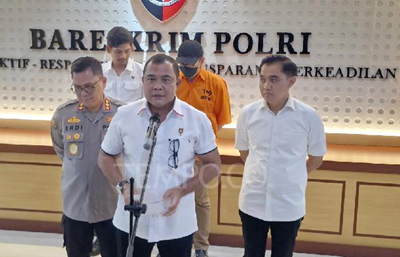 |
|
The
Indonesian National
Police (INP) Criminal
Investigation Agency
director, Brigadier
General, Nunung Syaifuddin,
centre, in Jakarta
Wednesday June 11,
2025 is investigating
UNESCO) World Heritage
listed Raja Ampat
region in West Papua,
also designated as
a UNESCO Global Geopark
for environmental
damage from nickel
mining
|
|
From News Reports:
Indonesia, June 18: The Indonesian
National Police (INP) Criminal Investigation
Agency is investigating alleged
environmental damage from nickel
mining on the (UNESCO) World Heritage
listed, Raja Ampat Islands in West
Papua, that are also designated
as a UNESCO Global Geopark, reports
Tempo.
The investigation of alleged environmental
damage is regulated by the environmental
law on Environmental Protection
and Management, with Brigadier General
Nunung Syaifuddin, saying ''four
nickel mining permits on four Raja
Ampat islands have been revoked
by the Ministry of Energy and Mineral
Resources of Indonesia.'''
Brigadier General Nunung Syaifuddin,
said the Indonesian National Police
have found environmental damage
on four Raja Ampat Islands, saying
''the police have the authority
to investigate allegations of environmental
damage under Environmental Law No.
32 of 2009 on Environmental Protection
and Management.''
He said the Indonesian National
Police are investigating PT Kawei
Sejahtera Mining, PT Mulia Raymond
Perkasa, PT Anugerah Surya Pratama,
and PT Nurham, saying ''the four
nickel mines in the Raja Ampat Islands
in West Papua, have had their nickel
mining permits revoked.''
Minister of Energy and Mineral Resources,
Bahlil Lahadalia, said the decision
to revoke four nickel mining permits
was made after the ministry conducted
a field assessment, saying ''only
PT Gag Nikel had obtained a Work
Plan and Budget Plan (RKAB) for
2025.
''PT Kawei Sejahtera Mining, PT
Mulia Raymond Perkasa, PT Anugerah
Surya Pratama, and PT Nurham,''
have not applied for Work Plan and
Budget Plan (RKAB) for 2025,'' he
said.
He said that PT Gag Nikel has been
granted a concession area of 13,136
hectares on Gag Island, saying ''Gag
Island is not located within the
Raja Ampat Island UNESCO Global
Geopark,
''Visual and technical inspections
revealed that the coastal and marine
areas surrounding Gag Island remain
in good condition,'' he said.
He said that that the four nickel
mining permits that were revoked
in the Raja Ampat Islands in West
Papua were found to be in violation
of the Environmental Law No. 32
of 2009 on Environmental Protection
and Management.
"Some of these permits were
issued between 2004 to 2006 by regional
governments in accordance with the
previous Mining Law,'' he said.
Nickel miner, PT Anugerah Surya
Pratama on Manuran Island in the
Raja Ampat Islands, West Papua,
who is one of the four nickel miners
to have had their nickel mining
permits revoked, is a subsidiary
of the Chinese company PTWanxiang
Nickel Indonesia.
Chinese company PTWanxiang Nickel
is the local arm of a Chinese company
that operates a nickel smelter in
Indonesia
The
Southeast Asian Times
|
Singaporean,
who introduced F1
night racing to Singapore,
to enter plea on abetting
a public servant and
abetting the obstruction
of justice
|
|
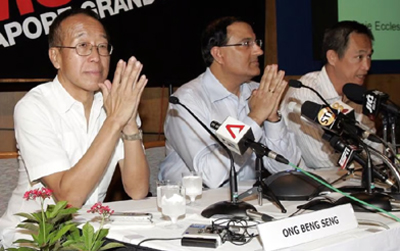 |
|
Singapore
GP Pte Ltd chairman
Ong Beng Seng, 79,
left, former Transport
Minister S. Iswaran,
63, centre, at press
conference announcing
approval of the International
Automobile Federation
(FIA) of the first
Formula One night
race at the Marina
Bay circuit on Sunday,
September 28, 2008
|
|
From
News Reports:
Singapore, June 17: Chairman, Ong
Beng Seng, 79, of Singapore GP Pte
Ltd the company that promotes and
organises the Singapore Grand Prix
and who is credited with bringing
the first Formula One F1 night race
to Singapore, is to enter a plea
on charges of abetting a public
servant in obtaining gifts and abetting
the obstruction of justice next
month, reports The Straits Times
Ong Beng Seng, 79, was charged on
October 4, 2024 with abetting former
Singapore Transport Minister S.
Iswaran, 63. in obtaining gifts
and with abetting the obstruction
of justice that is in violation
of Section 165 of the Penal Code
on corruption in the public service.
Former Transport Minister S. Iswaran,
63, pleaded guilty to 35 charges
that include receiving a business-class
flight from Singapore to Doha from
Singapore GP Pte Ltd chairman, Ong
Beng Seng, 79.
The Singapore Supreme Court handed
a 12 month prison sentenced on October
4, 2024 under Section 165 of the
Penal Code to former Singapore Transport
Minister S. Iswaran, 62, for accepting
gifts from Singapore GP Pte Ltd
chairman, Ong Beng Seng, 79.
Former Transport Minister S. Iswaran
pleaded guilty to 35 charges for
receiving valuables including a
business-class flight from Singapore
to Doha from Ong Beng Seng, 79,
chairman Singapore GP Pte Ltd.
Court documents show that Singapore
GP Pte Ltd. Ong, chairman, Beng
Seng, 79, had arranged for former
Transport Minister S. Iswaran, 63,
to fly business-class on Singapore
Airlines from Singapore to Doha
and return including a one-night
stay at the Four Seasons Hotel in
Doha.
Former Transport Minister S. Iswaran,
63, also received tickets to theatre
shows, football matches and the
Singapore F1 Grand Prix, whisky,
including international flights
and a hotel stay with the total
costs amounting to more than S$400,000.
Ong Beng Seng, 79, chairman Singapore
GP Pte Ltd. reportedly alerted Singapore
Transport Minister S. Iswaran, 62,
that the Singapore Corrupt Practices
Investigation Bureau had seized
the flight manifest for the December
22, trip from Singapore to Doha
return.
Singapore Transport Minister S.
Iswaran, 63. requested that Singapore
GP Pte Ltd. Ong, chairman, Beng
Seng, 79, bill the Transport Minister
for the flight to avoid investigation.
Singapore GP Pte Ltd. Ong, chairman,
Beng Seng, 79, who worked with the
Singapore Tourism Board (STB) to
promote the International Automobile
Federation (FIA) first Formula One
night race at the Marina Bay circuit
in 2008, was charged on October
4, 2024 with abetting a public servant
in obtaining gifts and with abetting
the obstruction of justice
He was scheduled to plead on April
2, 2025 but his case was adjourned
to July 3, 2025 after his lawyers
requested more time to obtain a
medical report.
The
Southeast Asian Times
|
Thailand-Cambodia
border dispute remains
unresolved after Joint
Boundary Commission
meeting
|
|
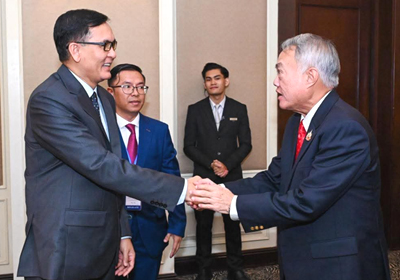 |
|
Thailand
Ambassador Prasas
Prasasvinitchai, left,
and Cambodia Minister
Lam Chea, right, meet
at the 6th Joint Boundary
Commission (JBC) at
the Sofitel in Phnom
Penh, Cambodia on
Saturday June 14,
2025
|
|
From
News Reports:
Phnom Penh, June 16: Thailand Ambassador
to Cambodia, Prasas Prasasvinitchai,
who has rejected Cambodia's proposal
for the Thailand- Cambodia border
dispute to be settled by the International
Court of Justice (ICJ) in The Hague,
said ''the border dispute should
be resolved by the Joint Boundary
Commission (JBC),'' at the 6th Cambodia
- Thailand Joint Boundary Commission
(JBC) meeting with Cambodia in Phnom
Penh on Saturday, reports Reuters.
Thailand Ambassador to Cambodia,
Prasas Prasasvinitchai, met with
Cambodian Minister, Lam Chea, Secretariat
of State of Border Affairs to discuss
the resolution of the Thailand-Cambodia
border conflict with Cambodian Minister,
Lam Chea, Secretariat of State of
Border Affairs saying after the
6th Cambodia–Thailand Joint
Border Commission (JBC) meeting
with Thailand Ambassador to Cambodia,
Prasas Prasasvinitchai, ''the meeting
went smoothly'' without releasing
official details regarding the outcome
of the meeting.
Cambodia Senate President, Hun
Sen, said ahead of the 6th Cambodia
- Thailand Joint Boundary Commission
(JBC) on Saturday ''the dispute
will clearly remain unresolved
through the existing Joint Boundary
Commission (JBC) mechanism into
the next century.''
''The areas of dispute that spans
over most of the 800 kilometre
border between Thailand and Cambodia
will clearly remain unresolved
through the existing Joint Boundary
Commission (JBC) into the next
century,'' he said,
Cambodia Prime Minister Hun Manet
said that Cambodia will ask for
the International Court of Justice
(ICJ) in The Hague for
intervention with or without Thailand’s
participation, saying ''Cambodia
will unilaterally submit a complaint
to the International Court of
Justice (ICJ) in the four disputed
areas, Ta Moan Thom, Ta Moan Toch,
Ta Krabey, and Mom Tei.''
''The Ministry of Foreign Affairs
and International Cooperation
will send a formal letter to the
International Court of Justice
(ICJ) on Sunday, June 15, 2025,''
he said.
The Cambodia Ministry of Foreign
Affairs and International Cooperation,
Prak Sokhonn, claims that the
Cambodian presence at the Preah
Vihear province location was recorded
in a Memorandum of Understanding
(MoU) on border demarcation and
marker placement in 2000.
Thailand Foreign Ministry spokesman
Nikorndej Balankura said that
the Cambodian assertion that the
disputed un-demarcated border
military post in Techo Morodok
village, Morodok commune, Choam
Ksan district, Preah Vihear province
belonged to Cambodia ''carries
no weight or consequence.''
In November 2013 the United Nations
International Court of Justice
(ICJ) in the Hague, in an unanimous
decision, ruled that the immediate
area surrounding the 11th century
Preah Vihear Hindu temple on the
Thailand Cambodia border belongs
to Cambodia.
"Cambodia holds sovereignty
over the whole territory of the
promontory of Preah Vihear,"
said International Court of Justice,
Judge Peter Tomka after the court
decision.
The judge, one of seventeen, said
that as a consequence of the decision
Thailand was now under obligation
to withdraw Thailand military
or police forces or other guards
or keepers who were stationed
in the immediate area surrounding
the temple.
The
Southeast Asian Times
|
Indonesia's
military recruits
24,000 soldiers for
'Development Territorial
Battalion' for rural
development
|
|
%20on%20Thurs%2020%20Mar%202025.jpeg.jpg) |
|
Students
from Trisakti University
in Jakarta, Indonesia's
largest private University,
protest against the
passing of the revised
TNI law that allows
the presence of Indonesian
National Armed Forces
on campus, at the
House of Representatives
(DPR) on Thursday
March 20, 2025
|
|
From News Reports:
Jakarta, June 15: The Civil Society
Coalition for Security Sector Reform
condemned the Indonesian National
Armed Forces (TNI AD) plan to recruit
24,000 soldiers to form a 'Development
Territorial Battalion '' with TNI
AD Information Service, Brigadier
General Wahyu Yudhayana, saying
''the recruits are not intended
for combat purposes,'' reports Tempo.
'The soldiers recruited to form
a 'Development Territorial Battalion'
will be focused on food security
and health services in rural Indonesia,''
he said.
He said the 24,000 recruits will
be focused on supporting rural
development in agriculture, livestock,
fisheries and health services,
saying ''the recruits are not
intended for combat purposes.''
Civil Society Coalition for Security
Sector Reform, representative
Indonesian Human Rights Watch
(Imparsial) Director Ardi Manto
Adiputra said ''soldiers in the
Indonesian National Armed Forces
are recruited, trained, and educated
for war,''
''Not for non-combat purposes,''
he said.
He said that the recruitment of
soldiers to form a 'Development
Territorial Battalion '' to support
rural development ''fails to maintain
the demarcation between civil-military
relations.''
He said that the National Armed
Forces (TNI) operations in civilian
society are not based in the provisions
of the TNI Law, saying ''Article
7 Paragraph 3 of the TNI Law regulates
the involvement of TNI operations
in civil society in war only.''
''The National Armed Forces (TNI)
operations in civilian society
are not based in the provisions
of the TNI Law, '' he said.
The Civil Society Coalition for
Security Sector Reform claim that
the National Armed Forces (TNI)
operations in non-military operations
deviate from the National Armed
Forces (TNI) mandate as a national
defence force as stipulated in
the constitution and TNI Law.
On June 6 the Constitutional Court
dismissed five petitions that sought
to repeal the National Armed Forces
(TNI) Law that was passed in the
House of Representatives (DPR) on
March 20, 2025 that extended the
role of the armed forces into government
institutions with nine judges saying
'' the petitioners had failed to
present sufficient evidence to demonstrate
their legal standing,''.
The five petitioners are the first
to challenge the revision of the
National Armed Forces (TNI) Law
that was passed by the House of
Representatives (DPR) on March 20,
2025.
The petitioners who are students
from the University of Indonesia
(UI) and Malang's Brawijaya University
(UB), argue that ''the legislative
process lacked transparency and
excluded public participation.''
Justice Saldi Isra said the petitioners,
"failed to show they had
attempted to participate in the
legislative process, whether through
public discussion or essays addressed
to policymakers,"
"Therefore, we concluded
that the petitioners had no legal
standing," he said.
The
Southeast Asian Times
|
Vietnamese
scammers arrested
in raids on 'Romance
Scam' centres in Thailand
|
|
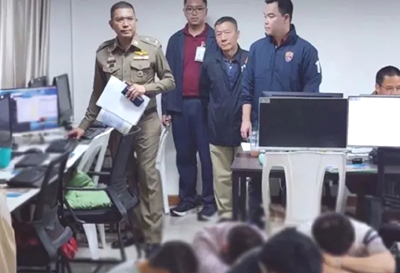 |
|
The
Metropolitan Police
Bureau, a unit of
the Royal Thai Police
(FTP) including Emergency
Response raided houses
in Bangkok used by
Vietnamese 'Romance
Scam' operators arresting
27 Vietnamese nationals
on Tuesday June 10,
2025
|
|
From
News Reports:
Bangkok, June 14: Vietnamese nationals
were arrested in raids on 'Romance
Scam' centres in rented houses
in Bangkok for defrauding Vietnamese
of more than US$1 million a month,
with the Royal Thai Police (RTP)
seizing 116 mobile phones, 45
computers and 5 grams of the drug
Ketamine in the raid, reports
the Nation.
Metropolitan Police Bureau Special
Branch and the Emergency Response
Unit of the Royal Thai Police
(RTP), raided two houses used
by the Vietnamese 'Romance Scam'
operators arresting 27 Vietnamese
nationals.
Pol. Maj. Gen. Nopasin Poolsawat,
said that 27 Vietnamese nations
were arrested at the two houses
outside Bangkok on Tuesday
after complaints from the public
''about a suspicious group of
foreigners occupying the rented
houses.
''Investigations revealed that
the Vietnamese suspects had entered
Thailand from Vietnam through
the Khlong Luek border checkpoint
in Sa Kaeo province,'' he said.
He said that the 27 Vietnamese
of five women and 22 males have
been operating the 'Romance Scam'
in Thailand since October 2024,
saying the Vietnamese scam operators
entered Thailand on 60 day tourist
visas.''
He said the 'Romance Scam' operation
was designed to target other Vietnamese
nationals, saying ''the scammers
established trust and cultivated
a romantic connection.
''The scammers would manipulate
victims into transferring money
with made-up debts or hardships
in an effort to elicit sympathy,''
he said.
He said the Vietnamese victims
were lured into emotional relationships
with the scammers via the Vietnamese
messaging app ''Zalo''.
''Each member of the Vietnamese
'Romance Scam' operation was assigned
to a dedicated computer terminal
working in shifts to maintain
round-the-clock operations,''
he said.
He said that the Metropolitan
Police Bureau Special Branch investigation
estimates that each computer generated
fraudulent transfers worth about
US$46,087.00 per month, saying
''the total Romance Scam operation
brought in US$1,203,908.00 a month.
He said the 27 Vietnamese suspected
scammers admitted to renting the
two houses outside Bangkok since
October 20, 2024 at US$926.00
and US$1,235.00 per month , saying
''successful scams earned bonuses
of $US772.00 .''
The
Southeast Asian Times
|
Thai
arrested for Facebook
photo postings of
explosions on disputed
Thailand-Cambodia
border
|
|
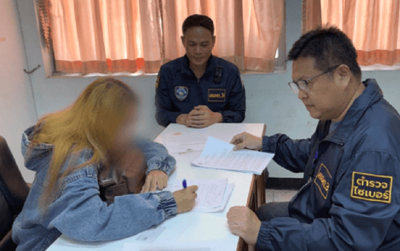 |
|
Phiranya,
32, left, was charged
with importing false
of forged cyber photos
of explosions and
military casualties
on the Thailand-Cambodia
border under the Computer
Crime Act 2007 on
Monday June 9, 2025
|
|
From
News Reports:
Bangkok, June 13: Thailand's Cyber
Crime Investigation Bureau (CCIB)
of the Royal Thai Police arrested
Phiranya, 32, at her home in Tambon
Kut Lat, Amphoe Mueang, Ubon Ratchathani
Province on Monday for posting
alleged false or forged cyber
photos of explosions and military
casualties on the Thailand-Cambodia
border, after a warrant was issued
by the Khon Kaen Provincial Court,
reports the Bangkok Post.
Phiranya, 32, is charged with
importing false of forged computer
data into a computer system under
the Computer Crime Act 2007 in
violation of Article 14(2) and
Article 20 of the Act.
Cyber Crime Investigation Bureau
(CCIB) of the Royal Thai Police,
Police Colonel Arunphan Vanichanun,
said at a press conference in
Bangkok on Monday that Facebook
user ''Lucky Farm'' identified
as Phiranya, 32, posted false
information about the Thailand
Cambodia border dispute.
''Facebook user ''Lucky Farm claimes
that explosions and military casualties
on the border led to evacuation
orders,'' said Police Colonel Arunphan
Vanichanun.
He said that the claims made by
Facebook user 'Lucky Farm'' identified
as Phiranya, 32, ''while untrue
had garnered significant attention
and could potentially threaten
national security.''
He said that Facebook user ''Lucky
Farm'' identified as Phiranya,
32 has admitted to posting the
misleading content.
He said that Phiranya, 32, claims
she acted on social media information,
saying ''she was allegedly influenced
by her personal bias regarding
the border disputes,''
He said that Phiranya, 32, claims
that that there was no factual
basis behind her claims and denied
any intention to profit from the
Facebook postings.
Thailand Foreign Ministry spokesman
Nikorndej Balankura said that
the Cambodian claim that the disputed
border military post in Techo
Morodok village, Morodok commune,
Choam Ksan district, Preah Vihear
province belonged to Cambodia
''carries no weight or consequence.''
''The Thailand military acted in
accordance with the rules of engagement
and both international and Thailand
laws during its confrontation with
Cambodian troops on May 28 after
the fatal shooting of a Cambodian
soldier in Preah Vihear province,''
he said.
He claims that Thailand adhered
to all necessary laws to protect
its sovereignty and ensure the
safety of its personnel, saying
''Thailand's response was appropriate
and measured.''
Thailand Foreign Ministry spokesman
Nikorndej Balankura said that
Thailand did not recognise the
jurisdiction of the International
Court of Justice (ICJ) after Cambodia
said it would refer the border
dispute to the International Court
of Justice (ICJ) in the Hague,''
Cambodia Deputy Prime Minister,
Ministry of Foreign Affairs and
International Cooperation, Prak
Sokhonn called for an investigation
into the May 28 fatal shooting
of a Cambodian soldier in Preah
Vihear province, saying in a diplomatic
note to the Thailand Embassy in
Phnom Penh ''Thailand soldiers
had attacked Cambodian soldiers
at a Cambodian military post in
Techo Morodok village, Morodok
commune, Choam Ksan district,
Preah Vihear province.
''The Royal Government of Cambodia
demands an urgent and thorough
investigation into the death of
the Cambodian soldier on the Thailand-Cambodia
border, saying ''those responsible
for this cruel and illegal act
must be brought to justice.''
The
Southeast Asian Times
|
Five
'Pig butchering' scammers
in Cambodia plead
guilty to extracting
millions from U.S
victims
|
|
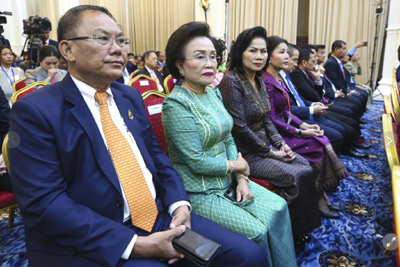 |
|
Ly
Yong Phat, left, at
ceremony for return
of cultural treasures
of artifact statues
ceremony at Peace
Palace in Phnom Penh,
Cambodia, Thursday,
August 22, 2024 was
sanction by the United
States Treasury Department
for serious human
rights abuses for
the treatment of workers
subjected to forced
labour in international
cryptocurrency-based
scam centres in Cambodia
on Thursday September
12, 2024
|
|
From News Reports:
Phnom Penh, June 12: Five scammers
pleaded guilty for their involvement
in an international cryptocurrency
scam known as 'Pig butchering' for
the extraction of USD36.9 million
from United States victims from
scam centres in Cambodia, with the
funds transferred to a bank in the
Bahamas, reports the United States
Attorney's Office (USAO).
Joseph Wong, 33, of Alhambra; Yicheng
Zhang, 39, of China; Jose Somarriba,
55, of Los Angeles; Shengsheng He,
39, of La Puente; and Jingliang
Su, 44, of China and Türkiye
were involved in international cryptocurrency
scamming known as 'Pig butchering'
that transferred funds from United
States victims to United States
banks and transfer to a single bank
account in the Bahamas.
The five men extracted funds from
United States victims for investment
in the international cryptocurrency
fraud scheme from social media interactions,
telephone calls, text messages and
online dating services from Cambodian
scam centres.
''The scammers in Cambodia told
United States victims who had invested
in the international cryptocurrency
fraud scheme that their investment
was appreciating, when in fact their
assets and funds had been stolen
and not invested at all,'' reports
United States Attorney's Office
(USAO).
The United States victim funds were
transferred from United States bank
accounts to a single account at
the Deltec Bank in the Bahamas and
converted to stablecoin Tether (USDT).
The stablecoin Tether (USDT) international
cryptocurrency was transferred to
scam centres in the region including
to Sihanoukville in Cambodia.
The five scammers who pleaded guilty
for their involvement in an international
cryptocurrency-based scam known
as 'Pig butchering' are part of
a larger effort by the United States
Justice Department to shut down
the international cryptocurrency-based
scam.
The guilty plea from the five scammers
operating from scam centres in Cambodia
follows the United States official
designation of the Huione Group
also known as the Huione Real Estate
Group, a China conglomerate that
operates in Hong Kong and China,
as an institution of primary money
laundering concern and has proposed
severing the Huione Group access
to the United States financial system.
The United States Attorney's Office
(USAO) reports that Senior Cambodian
officials in the Cambodian financial
conglomerate Huione Group that has
been used to transfer billions through
international cryptocurrency-based
scam known as 'Pig butchering' have
deep ties to the Cambodian ruling
party Cambodian Peoples Party (CPP).
The
Southeast Asian Times
|
''Cambodia's
scam industry is now
to big to fail,''
says United States
report
|
|
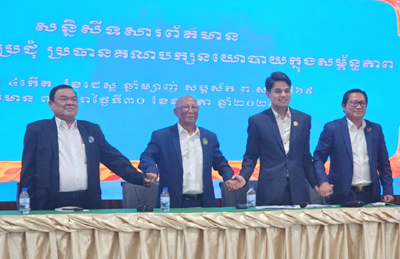 |
|
Cambodian
Peoples Party (CPP)
spokesman, third from
left, Chea Thyrith,
at meeting of 29 political
party leaders in Phnom
Penh agree to work
together to prevent
extremist politics
in Cambodia in Phnom
Penh Friday, May 30,
2025
|
|
From News Reports:
Phnom Penh, June 11: The Cambodian
Peoples Party (CPP) dismissed the
United States Institute of Peace
(USIP) Office on Drugs and Crime
report, titled ''Policies and Patterns:
State-Abetted Transnational Crime
in Cambodia as a Global Security
Threat,'' saying ''the report’s
findings are politically driven,''
with the author of the report, Jacob
Daniel Sims, saying ''Cambodia’s
scam industry is now too big to
fail,'' reports the Cambodia Daily.
Cambodian People’s Party (CPP)
spokesman, Chea Thyrith, dismissed
the report titled ''Policies and
Patterns: State-Abetted Transnational
Crime in Cambodia as a Global Security
Threat,' published on May 16, accusing
the author, Jacob Daniel Sims, of
''attempting to damage Cambodia's
reputation.''
Author of the report, Jacob Daniel
Sims, claims that ''senior government
officials in Southeast Asia including
Cambodia are entangled in criminal
networks that have grown increasingly
powerful and difficult to dismantle.''
''Criminal networks that are often
intertwined with state officials
have become deeply entrenched and
increasingly sophisticated,'' 'he
said.
He said the report is based on interviews
with almost 100 sources including
diplomats, journalists, business
people and researchers, claiming
''Cambodia is a key hub for transnational
criminal operations.''
The report claims that members of
ruling Cambodian Peoples Party (CPP)
are principal offenders in human
trafficking for the global cyber
scam industry saying ''indictments,
sanctions, visa bans and other accountability
measures are recommended by the
sources for 28 government officials
and businesspeople.''
Cambodian People’s Party (CPP)
spokesman, Chea Thyrith, claims
that the global cyber scam industry
is a regional problem, saying ''preventing
scams is no easy task and cannot
fall solely on the shoulders of
one government.''
''Scam prevention requires international
cooperation, and each country must
educate its people about the risks
to support prevention efforts,''
he said.
Jacob Daniel Sims claims that raids
by the Cambodian National Police
on global cyber scam industry workers
in Cambodia and the creation of
an inter-ministerial committee are
''rhetorical and performative''
.
'The occasional police raid and
a ministerial committee shield the
perpetrators, deflect scrutiny and
fall short of meaningful reform,''
he said.
He said that the Cambodian government
actions to date make the strongest
case for the central argument in
the report that ''Cambodia’s
scam industry is now too big to
fail.''
''The Cambodian government is too
deeply invested to change course
unless profound shifts in incentives
occur,'' he said.
The report states that data pointing
to a growing scam economy of up
to 60 percent GDP, with annual revenues
estimated at $12.5 billion to $19
billion, ''far exceed the garment
sector.''
The
Southeast Asian Times
|
Review
of ''No Further Action''
decision wanted in
death of former reporter
at headquarters of
Malaysia Anti-Corruption
Commission in 2009
|
|
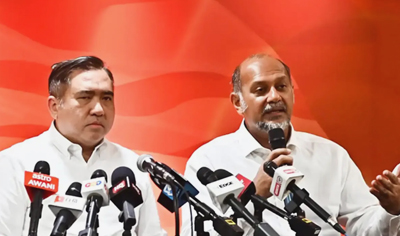 |
|
Malaysia's
opposition Democratic
Action Party (DAP)
chairman Gobind Singh
Deo, left, and secretary-general
Loke Siew Fook, right,
support family of
late Teoh Beng Hock,
31, in review of ''No
Further Action'' decision
by Attorney General
|
|
From
News Reports:
Kuala Lumpur, June 10: Malaysia's
opposition Democratic Action Party
(DAP) said the party will support
the family of the late Teoh Beng
Hock, 31, who was found dead at
the Malaysian Anti-Corruption
Commission (MACC) Selangor headquaters
after he was summoned for questioning
in 2009, in seeking a judicial
review against the Attorney General
decision to classify the investigation
as requiring No Further Action
(NFA) last month, reports, the
Star.
The Attorney General classified
the death of Teoh Beng Hock, 31,
the former reporter for the Chinese-language
newspaper, Sin Chew Jit Poh, and
assistant to Democratice Action
Pary member, Ean Toung Hian Wah,
as requiring No Further Action (NFA)
on May 21 after the submission of
the investigation by the Royal Malaysia
Police.
Opposition Democratic Action Party
(DAP) National chairman Gobind
Singh Deo and secretary-general
Anthony Loke said Attorney General
Dusuki Mokhtar must explain in
detail why he believes there is
insufficient evidence to prosecute
in the death of Teoh Beng Hock,
31.
''We have been informed that action
is being considered to challenge
the No Further Action (NFA) directive
in court by way of judicial review
by the Teoh Beng Hock family,''
said the Democratic Action Party
(DAP)
''We support this action and also
call upon the Attorney General
to review his decision and push
ahead with charges against those
responsible for Teoh Beng Hock's
death without further delay,''
it said.
In September 2024 the Court of Appeal
three-man panel, chaired by Judge
Ariff Md Yusof, ruled that the death
of Teoh Beng Hock, 31, on 15 July
2009 was caused by multiple injuries
from a fall from the 14th floor
of Plaza Masalam Tower, the headquarters
of the Anti-Corruption Commission
(MACC) due to or accelerated by
unlawful acts by unknown persons
inclusive of the Malaysian Anti-Corruption
Commission (MACC) officers involved
in the investigation.
In December 2011 High Court Judge
Abdul Rahim Uda upheld a coroner’s
“open verdict” following
an inquest into the death of Teoh
Beng Hock, 31 and dismissed a
request from the dead man’s
family that the finding be revised.
In January 2011 coroner Azmil
Mustapha Abas, found that he could
not decide if the death of the
former journalist who worked for
Ean Toung Hian Wah, a Democratic
Action Party member of the Selangor
legislative assembly and state
executive, was suicide or murder.
“We cannot use suspicion
…and hesitate in coming to
a finding …unless there were
testimonies that could prove the
suspicion,” said the judge
in supporting the coroner’s
verdict.
There was no evidence to prove
who committed the pre-fall injuries
found on the victim, said the
judge.
And he agreed that the evidence
put before the coroner did not
show anything that would implicate
a third party's role in causing
the victim's death, hence ruling
out homicide.
In July 2011 a Royal Commission
of Inquiry found that three Malaysian
Anti-Corruption Commission officers
drove political secretary Teoh
Beng Hock, 31, to suicide, saying
in the 124-page report that ''anti-corruption
personnel were then prepared to
go to great lengths to lie and
form a blue wall of silence in
the spirit of brotherhood.''
“Having considered all the
evidence in its entirety, we found
that Teoh was driven to commit
suicide by the aggressive, relentless,
oppressive and unscrupulous interrogation
to which he was subjected by certain
officers…'' said the report.
The
Southeast Asian Times
|
Australia's
Northern Territory
rejects independent
investigation into
death in police custody
of mentally disabled
Indigenous Australian
|
|
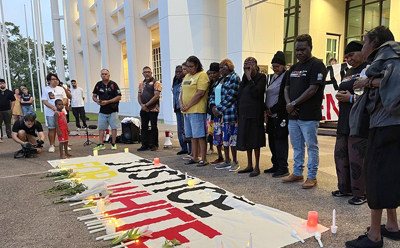 |
|
Candle-lit
vigil at the Northern
Territory Parliament
House in Darwin on
Wednesday June 4,
2025 calling for an
independent investigation
into the death of
mentally disabled
Indigenous Australian,
Kumanjayi White, 24
in police custody.
|
|
From
News Reports:
Darwin, June 9: The Northern Territory
Police and the Chief Minister of
the Northern Territory of Australia
have rejected calls for an independent
investigation into the death of
Kumanjayi White, 24, a mentally
disabled Indigenous Australian man
who died after being reportedly
''forcibly restrained by police
in Alice Springs,'' reports National
Indigenous Times.
Northern Territory Country Liberal
Party (CLP) Chief Minister Lia Finocchiaro
rejects calls for an independent
inquiry from the Warlpiri family
of Kumanjayi White, 24, saying ''spolice
are the right authority to carry
out an inquiry coupled with a coronial
inquiry.''
Minister for Indigenous Australians
in the Australian Labor Party (ALP),
Malarndirri McCarthy, called for
an independent investigation into
the death of Kumanjayi White, 24.
First Peoples Disability Network
(FPDN) Executive Officer, Worimi
man, Damian Griffis, advocate for
human rights of Aboriginal and Torres
Strait Islander people with a disability,
said ''Kumanjayi was a young man
with a significant disability who
needed culturally safe support,
not force.''
''The NT Police cannot investigate
themselves,'' he said.
''Australia has seen too many
families left without answers
and too many inquiries that gather
dust,'' he said.
Kumanjayi White, 24, grandfather
Warlpiri Elder, Ned Hargraves, said
his grandson was ''killed for no
good reason.''
"My grandson was not a criminal.
He was a quiet, young man,"
he said.
"What have we done to you.
We are suposed to be working together
in harmony but Police are taking
away our lives," he said.
Kumanjayi White, 24, a mentally
disabled Warlpiri Indigenous man,
who lived in Alice Springs in supported
accommodation under state guardianship
appointed by the Northern Territory
Civil and Administrative Tribunal
(NTCAT), died after being reportedly
''forcibly restrained by Alice Springs
police officers in the Coles supermarket
in Alice Springs.''
The Northern Territory Police claim
that Kumanjayi White, 24, was involved
in an altercation with a security
guard in the Coles supermarket in
Alice Springs, claiming ''two plainclothes
Alice Springs police officers retrained
Kumanjayi White, 24, who then lost
consciousness.''
The Northern Territory Police
reported that Kumanjayi White,
24, was transported to Alice Springs
Hospital and pronounced dead at
2.20pm on Tuesday May 27.
The Northern Territory Police
confirmed that a crime scene was
established at Coles, saying ''the
shopping centres remains closed.''
The Warlpiri family of Kumanjayi
White, 24, is calling for a fully
independent investigation that
would be removed from Northern
Territory Police control.
The Warlpiri family is also calling
for the immediate public release
of all CCTV and the footage from
body camera's worn by the Northern
Territory Police, suspension of
the officers involved while inquiries
proceed.
The Warlpiri family also called
for an end to public statements
that denigrade or criminalise
Kumanjayi White, 24.
The
Southeast Asian Times
|
Malaysia
ASEAN chair 2025 intervenes
in Thailand - Cambodian
border dispute
|
|
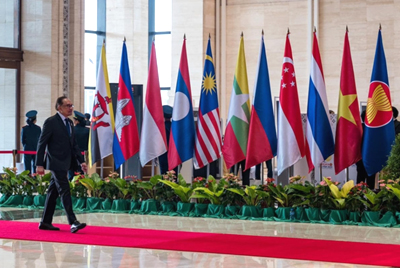 |
|
ASEAN
Chairman 2025, Malaysia
Prime Minister, Anwar
Ibrahim, is to intervene
in the Thailand and
Cambodian border dispute
in Bangkok on Saturday
7 June 2025
|
|
From
News Reports:
Kuala Lumpur, June 8: The Chairman
of the Association of South East
Asian Nations (ASEAN) for 2025,
Prime Minister of Malaysia, Anwar
Ibrahim, intervened in the armed
confrontation between Thailand
and Cambodian soldiers on 28 May
in the Emerald Triangle, a tri-border
region shared by Cambodia, Thailand
and Laos, saying on Friday ''as
the ASEAN Chair, Malaysia notes
the Cambodian call for International
Court of Justice (ICJ) in the
Hague jurisdiction,'' reports
the Star.
Cambodia Deputy Prime Minister,
Ministry of Foreign Affairs and
International Cooperation, Prak
Sokhonn called for an investigation
into the May 28 fatal shooting
of a Cambodian soldier in Preah
Vihear province, saying in a diplomatic
note to the Thailand Embassy in
Phnom Penh ''Thailand soldiers
had attacked Cambodian soldiers
at a Cambodian military post in
Techo Morodok village, Morodok
commune, Choam Ksan district,
Preah Vihear province.
''The Royal Government of Cambodia
demands an urgent and thorough
investigation into the death of
the Cambodian soldier on the Thailand-Cambodia
border, saying ''those responsible
for this cruel and illegal act
must be brought to justice.''
Thailand Foreign Ministry spokesman
Nikorndej Balankura said that
the Cambodian assertion that the
disputed border military post
in Techo Morodok village, Morodok
commune, Choam Ksan district,
Preah Vihear province belonged
to Cambodia ''carries no weight
or consequence.''
''The Thailand army acted in accordance
with the rules of engagement and
both international and Thailand
laws during its confrontation
with Cambodian troops on May 28,''
he said.
Thailand Foreign Ministry spokesman
Nikorndej Balankura claims that
Thailand adhered to all necessary
laws to protect its sovereignty
and ensure the safety of its personnel,
saying ''Thailand's response was
appropriate and measured.''
''Thailand did not recognise the
jurisdiction of the International
Court of Justice (ICJ) after Cambodia
said it would refer the border
dispute to the International Court
of Justice (ICJ) in the Hague,''
he said.
Cambodia Prime Minister Hun Manet
called on the International Court
of Justice (ICJ) in The Hague
to take action to resolve the
dispute between Thailand and Cambodia
over three ancient temples on
the Thailand-Cambodian border,
saying
''Cambodia wants the International
Court of Justice (ICJ) legal adjudication
to take action against the longstanding
dispute surrounding the Ta Moan
Thom, Ta Moan Toch and Ta Kro
Bei temples and the Mombei area,''
Cambodian Prime Minister Hun Manet
questioned Thailand's commitment
to resolving the border dispute,
saying ''Thailand should agree
to jointly bring the dispute to
the International Court of Justice
(ICJ) for a ruling without Cambodia
needing to file a case.
In November 2013 the United Nations
International Court of Jusice
(ICJ) in the Hague, in an unanimous
decision, ruled that the immediate
area surrounding the 11th century
Preah Vihear Hindu temple on the
Thailand Cambodia border belongs
to Cambodia.
"Cambodia holds sovereignty
over the whole territory of the
promontory of Preah Vihear,"
said International Court of Justice,
Judge Peter Tomka after the court
decision.
The
Southeast Asian Times
|
Vietnam
wants revision of
disciplinary action
for misconduct of
Communist Party of
Vietnam officials
|
|
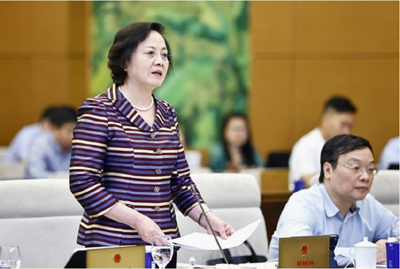 |
|
Vietnam's
Ministery of Home
Affairs, Head of the
Administrative Reform
Working Group, Pham
Thi Thanh Tra, proposes
new regulations that
require Communist
Party of Vietnam (CPV)
subordinates to comply
with decisions made
by superiors Thursday
June 5, 2025
|
|
From
News Reports:
Hanoi, June 7: Vietnam's Ministery
of Home Affairs, Head of the Administrative
Reform Working Group that is tasked
to research and propose new regulations
for disciplinary action for misconduct
by Communist Party of Vietnam
(CPV) officials and Civil Servants,
proposes new regulations that
require Communist Party of Vietnam
(CPV) subordinates to comply with
decisions made by superiors, reports
the Vietnam News.
Minister of Home Affairs, Head of
the Administrative Reform Working
Group, Pham Thi Thanh Tra, said
that draft revision 2025 Law on
Officials and Civil Servants requires
that a Communist Party of Vietnam
(CPV) subordinate, who believes
that a superior officials order
is unlawful, must report their concerns
in writing.''
''The proposed draft is intended
to replace existing regulations
and to introduce new exemptions
for disciplinary action in specific
cases,'' said Ministry of Home
Affairs, Pham Thi Thanh Tra.
''The provision aims to translate
broader policy direction in private
sector development for legal safeguards
for public officials,'' she said.
She said that Communist Party
of Vietnam (CPV) officials who
have caused loss to the State
due to unforeseen circumstances
may be exempt from disciplinary
action under the draft review
of 2025 Law on Officials and Civil
Servants.
''Communist Party of Vietnam (CPV)
officials who act in good faith
without self-interest but have
caused loss to the State due to
unforeseen circumstances may be
exempt from disciplinary action,''
she said.
The draft decree that proposes
new regulations for disciplinary
action for misconduct by Communist
Party of Vietnam (CPV) Officials
and Civil Servants stipulates
that wrongfully disciplined Officials
and Civil servants must receive
a formal apology and have their
entitlements reinstated.
''The apology aligns with Communist
Party of Vietnam (CPV) directives
aimed at ensuring fairness and transparency
in the disciplinary process,'' said
Minister of Home Affairs, Head of
the Administrative Reform Working
Group, Pham Thi Thanh Tra.
In January 2025 the Ministry of
Public Security recommended disciplinary
action against the Communist Party
of Vietnam (CPV) drafting team in
the Department of Electricity and
Renewable Energy (DERA for the development
of the Trung Nam - Thuan Nam Solar
Power Co. Ltd, power plant in Vietnam
after charging Vietnam's Deputy
Minister of Industry and Trade (MoIT)
, Hoang Quac Vuong, under Article
357 of the Penal Code 2015 with
abuse of power for by-passing the
Prime Minister to secure approval
for the Trung Nam - Thuan Nam Solar
Power Co. Ltd, inclusion in the
National Adaptation Plan (NAP).
Disciplinary action was also recommended
for officials at the Department
of Electricity and Renewable Energy
(DERA) for involvement in appraising
and evaluating the draft plan
for the development of the Trung
Nam - Thuan Nam Solar Power Co.
Ltd, in Vietnam.
Deputy Minister of Industry and
Trade (MoIT), Hoang Quac Vuong,
sought to implement a preferential
feed-in tariff of 9.35 US cents
per kWh, by-passing the prime
minister's authority, enabling
the Trung Nam - Thuan Nam Solar
Power Co. Ltd, to benefit.
The Ministry of Public Security
also recommended disciplinary
action against officials at the
Department of Electricity and
Renewable Energy (DERA) for granting
power operation licenses for the
operation of the Trung Nam - Thuan
Nam Solar Power Co. Ltd, that
was to begin in February 2025.
The
Southeast Asian Times
|
Indonesia
President Prabowo
claims Non-Governmental
Organizations sow
division in Indonesia
|
|
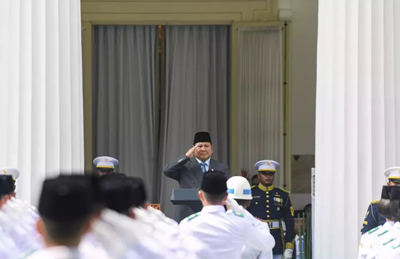 |
|
President
Prabowo Subianto claims
that Non-Governmental
Organizations attempt
to sow division within
Indonesia at Pancasila
Day ceremony in Jakarta
on Monday June 2,
2025
|
|
From
News Reports:
Jakarta, June 6: Indonesia claims
that foreign interests are sowing
division in Indonesia by funding
Non-Governmental Organizations
(NGOs), with President Prabowo
Subianto, saying ''external interference
persists under the guise of promoting
democracy,'' reports Tempo.
President Prabowo Subianto claimed
that ''external interference has
persisted for centuries and continues
today under the guise of
promoting democracy, human rights
and press freedom, ''at the Pancasila
Day ceremony in Jakarta on Monday.
''For hundreds of years, they’ve
tried to divide us,'' he said.
''Even now, they fund NGOs to
pit us against each other, all
while claiming to uphold democracy,
human rights, and freedom of the
press,'' he said.
President Prabowo Subianto urged
Indonesian to remain vigilant
and self-reliant, saying ''I’m
not calling on Indonesians to
be suspicious of foreign nations.''
He said that Indonesia must not
be manipulated by any country,
saying ''Indonesia must stand
on its own feet.''
He called for unity among Indonesians
despite differing backgrounds
and opinions, warning '' internal
divisions only benefit those who
wish to see Indonesia weakened.''
President Prabowo Subianto called
''for unity among Indonesians
despite differing backgrounds
and opinions,'' warning that ''internal
divisions only benefit those who
wish to see Indonesia weakened.''
He urged all Indonesians to unite,
saying ''let us not allow our
differences to be a source of
conflict.''
''That’s exactly what foreign
powers who dislike a strong and
prosperous Indonesia want.'' he
said.
In May 2016 China's National People's
Congress (NPC) Law Committee approved
new regulations for foreign Non
Government Organisations (NGO's)
that are registered in China,
with the National People's Congress
(NPC) Law Committee deputy head,
Xu Xianming, saying that the bill
regulates the activities of overseas
Non Government Organisations (NGO's)
in China.
He said that Non Government Organisations
(NGO's) involved in charity and
academia have grown in number
and their activities have intensified,
saying "it is necessary to
regulate and guide their activities."
The new law bans foreign Non Government
Organisations (NGO's) registered
in China from establishing organisations
in regional China, from recruiting
members in China and from raising
funds within China.
The new law also subjects NGO's
to financial scrutiny, requiring
that they submit annual reports
detailing their sources of financing,
expenditure and changes in personnel.
In July 2015 the National Assembly
in Phnom Penh passed a Law on
Associations and Non-Governmental
Organisations (NGO) aimed at regulating
the about 5,000 Non Government
Organisations (NGO) in Cambodia.
Under the new law all domestic
and international Non Government
Organisations (NGO) are required
to register their organisation
and to report their activities
and finances to the government.
Non Government Organisations (NGO)
in Cambodia will reportedly be
disbanded if their activities
"jeopardise peace, stability
and public order or threaten national
security, national unity, culture,
and traditions of Cambodian society".
Failure to comply will reportedly
result in fines, legal action
and possible disbandment.
Non Government Organisations (NGO)
in Cambodia will reportedly be
disbanded if their activities
"jeopardise peace, stability
and public order or threaten national
security, national unity, culture,
and traditions of Cambodian society".
The
Southeast Asian Times
|
Cambodia
calls on International
Court of Justice in
The Hague to resolve
border dispute with
Thailand
|
|
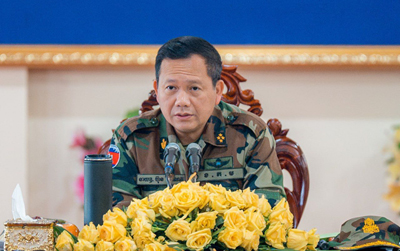 |
|
Cambodia's
Prime Minister, Hun
Manet, calls on the
International Court
of Justice (ICJ) in
The Hague to take
action to resolve
the Thailand and Cambodia
border dispute on
Tuesday June 3, 2025
|
|
From
News Reports:
Phnom Penh, June 5: Cambodia called
on the International Court of Justice
(ICJ) in The Hague to take action
to resolve the dispute between Thailand
and Cambodia over three ancient
temples on the Thailand-Cambodian
un-demarcated border, with Cambodia
Prime Minister warning that the
border clash on May 28 that left
a 48 year-old Cambodian soldier
dead has reignited tensions and
fuelled nationalist sentiments in
Cambodia,'' reports Phnom Penh Post.
''Cambodia wants the International
Court of Justice (ICJ) legal adjudication
to take action against the longstanding
dispute surrounding the Ta Moan
Thom, Ta Moan Toch and Ta Kro Bei
temples and the Mombei area,'' said
Cambodia Prime Minister Hun Manet.
Cambodian Prime Minister Hun Manet
questioned Thailand's commitment
to resolving the border dispute,
saying ''Thailand should agree
to jointly bring the dispute to
the International Court of Justice
(ICJ) for a ruling without Cambodia
needing to file a case.''
The Cambodian call for disputes
over the unmarked Thailand-Cambodia
border to be resolved by the International
Court of Justice (ICJ) in The
Hague, follows the Cambodia Deputy
Prime Minister, Ministry of Foreign
Affairs and International Cooperation,
Prak Sokhonn call for an investigation
into the May 28 fatal shooting
of a the unnamed Cambodian soldier
in Preah Vihear province.
The Cambodia Ministry of Foreign
Affairs and International Cooperation,
Prak Sokhonn, said in a May 29 diplomatice
note to the Thailand Embassy in
Phnom Penh that Thailand soldiers
had attacked Cambodian soldiers
at a Cambodian military post in
Techo Morodok village, Morodok commune,
Choam Ksan district, Preah Vihear
province.
''The attack by Thailand soldiers
had resulted in the unjust death
of an unnamed Cambodian soldier
at 5.30am on May 28,'' said the
diplomatic note.
He said that the Royal Government
of Cambodia demands an urgent
and thorough investigation into
the death of the unnamed Cambodian
soldier on the Thailand-Cambodia
border, saying ''those responsible
for this cruel and illegal act
must be brought to justice.''
The Cambodia Ministry of Foreign
Affairs and International Cooperation,
Prak Sokhonn, claims that the
Cambodian presence at the Preah
Vihear province location was recorded
in a Memorandum of Understanding
(MoU) on border demarcation and
marker placement in 2000.
Thailand Foreign Ministry spokesman
Nikorndej Balankura said that
the Cambodian assertion that the
disputed un-demarcated border
military post in Techo Morodok
village, Morodok commune, Choam
Ksan district, Preah Vihear province
belonged to Cambodia ''carries
no weight or consequence.''
''The Thailand army acted in accordance
with the rules of engagement and
both international and Thailand
laws during its confrontation
with Cambodian troops on May 28,''
he said.
Thailand Foreign Ministry spokesman
Nikorndej Balankura claims that
Thailand adhered to all necessary
laws to protect its sovereignty
and ensure the safety of its personnel,
saying ''Thailand's response was
appropriate and measured.''
In November 2013 the United Nations
International Court of Jusice
(ICJ) in the Hague, in an unanimous
decision, ruled that the immediate
area surrounding the 11th century
Preah Vihear Hindu temple on the
Thailand Cambodia border belongs
to Cambodia.
"Cambodia holds sovereignty
over the whole territory of the
promontory of Preah Vihear,"
said International Court of Justice,
Judege Peter Tomka after the court
decision.
The judge, one of seventeen, said
that as a consequence of the decision
Thailand was now under obligation
to withdraw Thai military or police
forces or other guards or keepers
who were stationed in the immediate
area surrounding the temple.
The International Court of Justice
(ICJ) ruled in 1962 that the temple
belonged to Cambodia, but both
Thailand and Cambodia claimed
ownership of the land surrounding
the temple included in the disputed
4.6 square kilometre area.
Tens of thousands were reportedly
displaced with about 28 killied
in the 2011 fighting leading Cambodia
to ask the International Court
of Justice for an interpretation
of the original 1962 ruling.
The
Southeast Asian Times
|
China
opens IOMed in Hong
Kong on par with International
Court of Justice and
Permanent Court of
Arbitration in The
Hague
|
|
 |
|
Representatives
from more than 80
countries and 20 international
organisations attend
the signing ceremony
for the convention
on the establishment
of the International
Organization for Mediation
(IOMed) including
the Association of
Southeast Asian Member
Nations (ASEAN) Indonesia,
Laos, Cambodia, East
Timor on Friday May
30, 2025
|
|
From
News Reports:
Hong Kong, June 4: The Communist
Party of China (CPC signed a convention
on the establishment of the International
Organization for Mediation (IOMed)
in Hong Kong on Friday, with Chief
Executive of the Hong Kong Special
Administrative Region (HKSAR) John
Lee, saying '' IOMed is on par with
the United Nations International
Court of Justice (ICJ) and the Permanent
Court of Arbitration (PCA) in The
Hague,'' reports Reuters.
Chief Executive of the Hong Kong
Special Administrative Region (HKSAR),
John Lee, who was sworn in as the
6th Chief Executive of Hong Kong
in 2022 by President of China, Xi
Jinping, said ''the International
Organization for Mediation (IOMed)
will be the first intergovernmental
body dedicated to mediation.''
''The IOMed would become increasingly
important amid mounting geopolitical
tensions,'' he said.
''When protectionism threatens
to derail the international trade
order and when unilateralism looms
over global supply chains, it
is dialogue not division that
restores balance,'' he said.
The International Organization
for Mediation (IOMed) was initiated
by the Communist Party of China
(CPC) in Beijing with Member of
the Political Bureau of the Communist
Party of China (CPC) Central Committee,
Director of the Office of the
Central Commission for Foreign
Affairs, Minister of Foreign Affairs,
Wang Yi, saying ''IOMed embodies
the principles of the United Nations
Charter prioritizing mediation
in international disputes under
Article 33.''
''The IOMed aims to transcend
a zero-sum and you-lose-I-win
mentality in global affairs,''
he said.
He said the stablishment of the
International Organization for
Mediation (IOMed) in Hong Kong
will promote the amicable resolution
of international disputes and
build more harmonious international
relations,” he said.
''The International Organization
for Mediation (IOMed) would fill
a gap in the field.'' he said.
Representatives from more than
80 countries and 20 international
organisations attended the signing
ceremony for the convention on
the establishment of the International
Organization for Mediation (IOMed)
on Friday, including the Association
of Southeast Asian Member Nations
(ASEAN) Indonesia, Laos, Cambodia,
East Timor.
In 2016 the judges of the Permanent
Court of Arbitration in the Hague
ruled that China had violated
the United Nations Convention
on the Law of the Sea (UNCLOS)
by invoking "historic rights"
in its claim over the West Philippine
Sea.
China rejected the Permanent Court
of Arbitration in the Hague ruling
with China Foreign Ministry spokesman,
Lu Kang saying then that "the
Permanent Court of Arbitration
in the Hague has no jurisdiction
on this matter."
"The dispute was not covered
by U.N. Convention on the Law
of the Sea (UNCLOS) because it
was ultimately a matter of sovereignty
not exploitation rights,'' he
said.
The
Southeast Asian Times
|
China
Ministry of Foreign
Affairs attacks US
for claiming that
China is a threat
to the US
|
|
 |
|
Rear
Admiral Hu Gafng of
the People’s
Liberation Army National
Defence University
in Bejing, led China's
delegation to the
22nd International
Institute for Strategic
Studies IISS Asia
Security Summit, 2025
Shangri-La Dialogue,
in Singapore from
May 30 to June 1,
2025
|
|
From
News Reports:
Singapore, June 3: China's Ministry
of Foreign Affairs has denouncedUnited
States Defense Secretary Pete Hegseth
for claiming that ''China is a threat
to the United States'' at the 22nd
International Institute for Strategic
Studies IISS Asia Security Summit,
2025 Shangri-La Dialogue, in Singapore
on Sunday, with the China saying
''the remarks were filled with provocations
and intended to sow discord,'' claims
China's Ministry of Foreign Affairs,
reports Reuters.
United States Defense Secretary
Pete Hegseth said at the 22nd International
Institute for Strategic Studies
IISS Asia Security Summit, 2025
''Washington will bolster its defenses
overseas to counter what the Pentagon
sees as rapidly developing threats
by Beijing, particularly in its
aggressive stance toward Taiwan.''
''China’s army is rehearsing
for the real deal,'' said United
States Defense Secretary Pete Hegseth.
''We are not going to sugarcoat
it the threat China poses is real.
And it could be imminent,'' he said.
China's Ministry of Foreign Affairs
claims ''the United States Defense
Secretary Pete Hegseth has deliberately
ignored the call for peace and development
by countries in the region.''
''United States Defense Secretary
Pete Hegseth has instead touted
the Cold War mentality for bloc
confrontation, vilified China with
defamatory allegations, and falsely
called China a threat,'' claims
China Ministry of Foreign Affairs.
China Ministry of Foreign Affairs
said that China deplores and firmly
opposes the claim made by the United
States Defense Secretary Pete Hegseth
that China is a threat to the United
States, saying ''China has protested
strongly to the United States.''
''The United States is the primary
factor undermining peace and stability
in the Asia-Pacific China's Ministry
of Foreign Affairs has accused the
United States of deploying offensive
weaponry in the South China Sea
to perpetuate United States hegemony
and advance the Indo-Pacific strategy,
saying ''the United States has stoked
flames and is creating tensions
in the Asia-Pacific.''
''The United States is the primary
factor undermining the peace and
stability of the Asia-Pacific,''
claims the China's Ministry of Foreign
Affairs.
In July 2016 Judges of the Permanent
Court of Arbitration in the Hague
ruled in favour of the Philippines
against China's claim of "historic
rights" over the South China
Sea.
The Permanent Court of Arbitration
in the Hague decision followed the
Philippine complaint in 2013 that
called on the court to intervene
in the Philippine dispute with China
over the right to exploit natural
resources including fish in the
West Philippine Sea.
The Judges of the Permanent Court
of Arbitration in the Hague ruled
in 2016 that China had violated
the United Nations Convention on
the Law of the Sea (UNCLOS) by invoking
"historic rights" in its
claim over the West Phillipine Sea.
China rejected the Permanent Court
of Arbitration in the Hague ruling
with China Foreign Ministry spokesman,
Lu Kang saying then that "the
Permanent Court of Arbitration in
the Hague has no jurisdiction on
this matter."
"The dispute was not covered
by U.N. Convention on the Law of
the Sea (UNCLOS) because it was
ultimately a matter of sovereignty
not exploitation rights,'' he said.
The
Southeast Asian Times
|
The
US states the United
States of America
is an Indo-Pacific
Nation
|
|
 |
|
U.S.
Secretary of Defense,
Pete Hegseth, stated
that 'the United States
is an Indo-Pacific
Nation'' at the 22nd
International Institute
for Strategic Studies
IISS Asia Security
Summit, 2025 Shangri-La
Dialogue in Singapore
on Saturday May 30,
2025
|
|
From
News Reports:
Singapore, June 2: The 22nd International
Institute for Strategic Studies
IISS Asia Security Summit, 2025
Shangri-La Dialogue, in Singapore
from May 30 to June 1 was attended
by 47 country representatives including
U.S. Secretary of Defense, Pete
Hegseth, Australian Deputy Prime
Minister and Minister for Defence,
Richard Marles, Japanese Minister
of Defense General Nakatani, who
convened the fifteenth Trilateral
Defence Ministerial Meeting (TDMM)
on 31 May 2025, with U.S. Secretary
of Defense Pete Hegseth, stating
at the Summit ''the United States
is an Indo-Pacific Nation,'' reports
US Defence.
"We share your vision of
peace and stability, of prosperity
and security and we are here to
stay," said U.S. Secretary
of Defense Pete Hegseth.
He said the future vision for
the Indo-Pacific is one grounded
in common sense and national interest,
saying ''the future vision for
the Indo-Pacific is one where
the U.S. and its allies work together
while respecting their mutual
self-interests and engaging on
the basis of sovereignty and commerce
as opposed to war.''
''The futures of the U.S. and
its Indo-Pacific allies are bound
together,'' he said.
U.S. Secretary of Defense Pete
Hegseth, said that U.S. President
Donald Trump continues to lead
Europeans to step up in their
self-defence, saying ''the U.S.
can then focus more on resources
on the Indo-Pacific region.''
''This enables all of us to benefit
from the peace and stability that
comes with a lasting and strong
American presence here in the
Indo-Pacific," he said.
"These benefits, they only
multiply when our allies and partners
are also strong," he said.
Australian Deputy Prime Minister
and Minister for Defence, Richard
Marles, said at the Trilateral
Defence Consultations Ministerial
Meeting Joint Statement on Efforts
to Deepen Our Defence Cooperation
at the 22nd International Institute
for Strategic Studies IISS Asia
Security Summit, 2025 Shangri-La
Dialogue in Singapore on May 31
that ''the trilateral partnership
ensures we are prepared to address
the most consequential challenges
in the Indo-Pacific.''
Australian Deputy Prime Minister
and Minister for Defence, Richard
Marles, said that Australia, United
States and Japan confirm our intention
to promote multilateral defence
industry cooperation in the Indo-Pacific
region, saying ''the success of
Defence and Security Equipment
International (DSEI) Japan 2025
confirms production sustainment
and supply chain cooperation of
opportunities, including the Partnership
for Indo-Pacific Industrial Resilience
(PIPIR) work stream efforts, with
the participation of our respective
public and private sectors.''
''We look forward to deepening
these defence industrial partnerships,
including by exploring collaborative
opportunities across our respective
defence industrial bases,'' said
Minister for Defence, Richard
Marles.
He said that the Trilateral Defence
Ministerial Meeting (TDMM) affirm
our shared ambition to further
expand cooperation with regional
partners in the Indo-Pacific,
saying ''India, the Philippines,
Republic of Korea reinforce deterence
and stability in the Indo-Pacific.''
Japan Defence Minister General Nakatani
introduced One Cooperative Effort
Among Nations (OCEAN) at the 22nd
International Institute for Strategic
Studies IISS Asia Security Summit,
2025 Shangri-La Dialogue, saying
''like-minded nations could work
together.''
Japan Defence Minister General
Nakatani called for closer defence
cooperation and coordination,
inclusiveness and transparency
and strengthening accountability
with the aim of restoring a rules-based
international order (RBIO) in
the Indo-Pacific region.
''There is a serious disregard
for accountability,'' he said.
''In the South China Sea, the
very country that previously declared
it had no intention of militarizing
the area is rapidly advancing
militarization.'' he said.
He said that there has been a
sharp increase in military buildup,
including nuclear forces lacking
transparency, and provocative
military activities in the region,
saying ''this poses a significant
obstacle to maintaining trust
in the defence arena.''
''Now is the time for countries
to join hands under OCEAN, engage
in dialogue, and work to restore,
rather than dissolve, the rules-based
international order (RBIO) to
realize, rather than ignore, accountability;
and to promote, rather than undermine,
the international public good,''
he said.
The
Southeast Asian Times
|
China
refuses Australia's
offer to buy back
China's 99 year lease
on Port Darwin in
Australia's Northern
Territory
|
|
 |
|
China's
Ambassador to Australia,
Xiao Qian, centre,
visits Port Darwin
in Darwin harbour
in Australia's Northern
Territory on Thursday
May 22, 2025
|
|
From
News Reports:
Darwin, June 1: China's Ambassador
to Australia has refused Australia's
offer to buy back Port Darwin in
Darwin harbour in Australia's Northern
Territory that was granted a 99
year lease in 2015, with China Ambassador
Xiao Qian warning Australia that
termination of the lease could undermine
Australia's reputation as a stable
and predictable country for foreign
investment, reports
''Plans by the Australian federal
government to take back Darwin
port is ethically questionable,''
said China's Ambassador to Australia,
Xiao Qian.
Shandong Landbridge Group Co.,
Ltd. from Shandong province in
China, secured the lease in Darwin
harbour through an open and transparent
bidding process fully compliant
with Australian laws and market
principles,'' he said.
''Over the past ten years the
Shandong Landbridge Group Co.,
Ltd. has made significant investments
in maintaining and building Darwin
Port’s infrastructure.
He said the Shandong Landbridge
Group Co., Ltd. efforts have brought
remarkable improvements to Port
Darwin, saying ''the investment
in the port has turned the financial
situation from losses to profits
and has contributed positively to
local economic and social development.''
''He said the original agreement
between the Northern Territory
government and Landbridge was
fully above board and should be
respected,'' saying ''Shandong
Landbridge Group Co., Ltd secured
the lease for the port in Darwin
through an open and transparent
bidding process.''
The lease agreement in 2015 between
Shandong Landbridge Group Co., Ltd.
chairman, Ye Cheng, who was the
winning bidder for the Darwin harbour
land deal worth A$506 million, and
the then leader of the Country Liberal
Party of the Northern Territory,
chief minister, Adam Giles gave
the Shandong Landbridge Group Co.,
Ltd. operational control of the
East Arm Wharf in Darwin harbour
in Australia's Northern Territory
including 80 percent ownership of
the land and facilities.
In April 2025 Shandong Landbridge
Group Co., Ltd. non-executive
director, Terry O'Conner, said
from Australia ''Port Darwin lost
$34.362m in 2024 as the Shandong
Landbridge Group Co., Ltd. chairman,
Ye Cheng, moved to refinance a
$107 million bond debt,'
He said that Shandong Landbridge
Group Co., is considering selling
assets in China to pay the debt,
saying ''Landbridge in China has
a portfolio of large infrastructure
assets.''
''Shandong Landbridge Group Co.in
China is looking to moderate its
debt, which will likely see the
sale of some assets across the
group,'' he said.
In 2020 Amendments to the Foreign
investment laws, that were made
by the Australian Parliament under
Prime Minister Scott Morrison,
gave the Australian Federal Government
the power to impose conditions
that include forced divestment
of previously approved foreign
investment deals, with then Prime
Minister Scott Morrison saying
"the new foreign investment
laws focus on protecting Australia's
national security."
"The new foreign investment
laws give the Australian Federal
Government the retrospective power
to review the port lease agreement
between the Northern Territory
government and China's Landbridge
Group Co., Ltd. in northern Australia
from a national security perspective,"
he said.
The
Southeast Asian Times
| The
Southeast Asian Times
wishes its readers
a happy Christmas
and all the best for
the New Year with
a special thankyou
to its treasured letter
writers |
|
|
| MEDIA CHECK |
| Cambodia-China Journalist Association
(CCJA)
launched
in
Phnom
Penh ...open
here |
|
|
|
Darwin
reporter
John Loizou
asks a
survivor
of the
1965 killings
in Bali
"why didn't
you try
to stop
them"
in "Remembering
the slaughter
in Paradise"
........open page here
|
|
| Kang-Fu
the Red
Kangaroo
is relentless
in his fight
to
protect
Australia's
sovereignity...Open
page
here | |
| Bombed
by
the Americans
for Christmas
in 1972,
Ha Noi Bach
Mai hospital
is still
a war zone...Christina
Pas
reports...Open
page
here | |
| Indigenous
Australians
in the northern
Queensland
town of
East Trinity
aim for
economic
independence
from
eco-cultural
tourism,
reports
Christine
Howes in
"Australian
indigenous
eco-cultural
tourism
venture
wins best
small project
national
award
"
...open
here
| |
| Kavi
Chongkittavorn
talks about
the UK
application
to become
an ASEAN
dialogue
partner
in "New
dynamics
of Aseans
external
ties,"
with consensus
yet to be
reached
on admitting
a
former
colonial
master of
four
ASEAN
member countries
into the
Southeast
Asian bloc....open
| |
| Esther
Samboh talks
about
the
choise between
thousands
dying
of
Covid-19
or from
hunger in
densely
populated
Jakarta
in the new
normal in
"Medics
dying, infections
soaring
- it's still
the economy"
...open
page
here | |
| Australian
reporter,
Chris Ray,
investigates
why Australia
dropped
five spots
in the World
Press Freedom
Index...open | |
| Read
what Son
Nguyen has
to say about
the impact
of China's
virus on
Vietnam's
economy
in
"When
the
economy
gets sick"
open
here | |
| Has
the ancient
Syrian city
of
Palmyra
suffered
a fatal
blow, or
will it
rise again?
asks Australian
reporter
Chris Ray...
Open
page
here | |
|
Darwin
reporter
John Loizou
asks a
survivor
of the
1965 killings
in Bali
"why
didn't
you try
to
stop
them"
in "Remembering
the slaughter
in
Paradise"
........open
page here
| |
| "Goodbye
America"
says B.A.
Hamzah as
he calls
for Asians
to determine
their own
political
destiny
in "Time
for Asia
to
set it's
own course,
minus the
U.S."...open
here | |
| Is
prescribed
burning
of
grasslands
in northern
Australia
out of control?
......Chris
Ray reports
...
open page
here | |
| "Rockefeller
and the
Demise of
Ibu
Pertiwi"
by Kerry
B. Collison
"is
undoubtedly
fictional
but by no
means improbable,
"
says Johannes
Nugroho
....open
page
here | |
Viet
Nam is
planning
to go nuclear
by the year
2020.reports
John
Loizou
in
"Calculating
the costs
of nuclear
energy in
Vietnam"
...open
page here
| |
|
The
founder
of the
Revolutionary
Front
of Independent
East Timor
(Fretilin),
Mari
Alkatiri,
the now
former
Prime
Minister
of Timor
Leste,
after
losing
the May
12, 2018
election
to the
National
Congress
for Timorese
Reconstruction
(CNRT)
party,
led by
Xanana
Gusmao,
has accused
the opposition
of a coup
attempt.
Twelve
years
ago Mari
Alkatiri
also accused
the opposition
of a coup
attemp
claiming
then that
the
crises
that led
to his
resignation
was the
result
of a conspiracy.
"I
have no
doubt
about
that"
he told
Darwin
reporter
John Loizou
in an
interview
in Dili
on 6 November
2006
......open
page here
| |
|
Cuba's
302
physicians
in East
Timor
work at
five hospitals
and remote
villages
throughout
the republic...writes
Darwin
reporter
John Loizou
...open
page here
| |
| Benedict
Anderson,
a man
without
a country,
dies in
Indonesia
Jeet Heer
reports.....open
page
here | |
|
Thousands
of Northern
Australia's
indigenous
rock art
sites
are under
threat
from buffalo,
fire and
feral
animals.
Tim Lee
reports
........open
page here
| |
| Copy
of
letter
29 May 2012
from Vietnam
Womens Union
to
International
Olympic
Committee...open
here | |
| The
Southeast
Asian Times
wishes its
readers
a
happy
Christmas
and all
the best
for the
New Year
with a special
thankyou
to its treasured
letter
writers
| |
| The
Southeast
Asian
Times
wishes
its readers
a happy
Christmas
and all
the best
for the
New Year
with a
special
thankyou
to its
treasured
letter
writers
|
|
Published
by Pas Loizou Press
Darwin Northern
Territory
Australia
PASLOIZOUPRESSDARWIN@bigpond.com
|
The
Southeast
Asian
Times cannot
be
bought
|
|
| |
|
|
| |
|
|
|
|
|
Oz $ buys
|
|
Updated
daily.
Prices indicative only
|
US...0.7582
Brunei...1.0310
Cambodia...3,115.36
China..Yuan..5,0710
East Timor...0.7582
Euro..0.6794
HongsKong...5.8808
Indonesia Rupiah.9,997.47
Japan..78.8528
Laos..6,140.58
Malaysia Ringgit.....3.0900
Myanmar..923.19
Viet Nam Dong..16,849.44
Singapore
properties listed for sale in Myanmar
From News Reports:
Yangon, November 25: Singapore's largest property developer, the
Far East Organization, is to partner with Myanmar's property sales and marketing company, Min Zin Agency, in
Yangon to sell condos in Singapore.
Managing director of the Min Zin Agency in Yangon, Ko Kyaw Min
Zin, said that Singapore's Far East Organization has expanded
its sales and marketing efforts into Myanmar.
“The Far East Organisation has been selling their Singapore properties
to Myanmar buyers since 2009,” he said.
The Far East Organisation reportedly have over 750 properties
in Singapore’s residential, hospitality, retail, commercial and
industrial sectors,
including 45,500 or one in every six private homes in Singapore
listed with the Min Zin Agency in Yangon.
The Southeast
Asian Times
China to invest in rail and road construction
in Indonesia
From News Reports:
Jakarta, November 10: Indonesia's Railway
Corporation (PT KAI) and state construction company PT Jasa Marga
signed a memorandum of understanding
(MoU) with China Investment Fund (CIF) to develop indonesia's
railway services and toll road construction.
Witness to the signing, coordinating Minister for the Economy
Sofyan Djalil, said that the MoU will provide the groundwork for
further cooperation between China Railway and P KAI and China
Investment Fund (CIF).
"The MoU is the first step towards further development of public
services between China and Indonesia" he said.
Chinese Ambassador to Indonesia, Xie Feng said that the MoU would
spark more cooperations between China and Indonesia and would
bring about "real benefits to the public."
The Southeast Asian Times
Penang health department
shuts down soya bean factory
From News Reports:
Penang, October 19:
Five Penang food factories including a 100 year old
soya bean factory at Tanjong Bungah were ordered closed
by the state health department for failure to observe health
standards.
State health, food safety and quality
division, deputy director Ku Nafishah Ku Ariffin
said soya bean products were processed in an unclean
"rusty and moldy kitchen".
"Our inspectors found
that wet products were left to dry on "dirty" bamboo
sticks along with bathing towels. The bamboo sticks
were also dirty and dusty," she said.
A "sweets"
factory in Teluk Kumbar, a noodle factory in Simpang
Ampat and a sauce factory in Bukit Metajam were also
closed by the state health department
The Southeast Asian
Times
Fuel smugglers including military personnel
under arrest
From News Reports:
Jakarta, September 15: Riau Islands Police have arrested
30 suspects including several Indonesian Military
(TNI) personnel and seized 64 cars, two boats and
106 tons of fuel.
Riau Islands Police chief Brig.
Gen. Arman Depary said in Batam last week that the
seized cars had been modified to hold 100 litres of
fuel.
"The Military (TNI) personnel are suspected
of fuel smuggling and have been handed over to the
military base", he said.
TNI Commander Gen.
Moeldoko said that the alleged suspected fuel
smugglers are honor-based service military personnel.
The Southeast Asian
Times
Thai coup blammed for fall in tourist
arrivals
From News Reports:
Bangkok, August 18: The Thai tourism sector suffered its largest
fall in international visitors to Thailand in June, the
first month after the establishment of marshal law
and the military seizure of the Yingluck Shinawatra
government.
Tourism reportedly accounts for 10
percent of the Thai economy.
Data from the Thai
Department of Tourism shows that inernational
tourist arrival numbers in July fell by 10.9 percent compared
to the same time last year.
International arrivals in July totalled 1.91 million compared
to 2.15 million in July 2013.
Arrivals
from China with a18 percent share of all visitors to
thailand and the largest group of visitors to Thailand, fell by
25.3 percent.
Arrivals from the United
Kingdom with a 4 percent share of all visitors to
Thailand, was one of the few large markets to record
a gain, of 6.2 percent
The Southeast Asian
Times
US Senate approves sales of nuclear
equipment to Vietnam
From News Reports:
Hanoi, July 31: The US Senate Committee on Foreign Relations
passed legislation approving a 123 agreement on
civil nuclear commerce with Vietnam at a business
meeting of the committee last week.
The 123
agreement under the US Atomic energy Act of 1954 establishes
a civil nuclear commerce agreement that allows the US to
export nuclear reactors, research information and
equipment to Vietnam.
The civil nuclear commerce
agreement between the US and Vietnam is "part of
Vietnam's effort to ease its shortage of energy
towards meeting over 10 percent of the domestic power demand by
2030", reports the Vietnam News Service
The Southeast Asian
Times
Court for
construction
Industry
established
in Malaysia
From
News Reports:
Kuala Lumpur, May 3: The first two
Construction Courts for Malaysia were opened by
Chief Justice Tun Arifin Zakaria in Kuala Lumpur and
Shah Alam last week, reports the Star.
The courts
will deal with disputes in the construction industry.
Works Minister Datuk Haji Fadillah bin Haji Yusof said that the
establishment of the courts will transform the way
the construction business in the country
operates.
"The construction industry
stakerholders can now have their disputes resolved
by judges with expert knowledge and experience in
construction industry disputes', he said.
The
proposal by the Construction Industry Board (CIDB) for the
establishment of the construction courts was first put to the
Judiciary in January 2013.
Britain
is the only other country that has a specially designated
court that deals with construction industry disputes.
The
Southeast Asian Times
Bali communities want larger share of tourism revenue
From News Reports:
Denpasar, April 14: Bali
community-based tourism operators have called for
amendments to regulations that stipulate that the local
community pay the Bali regency administration 60 percent of their
total tourism revenue.
Penglipuran tourist village in Bangli, community-based tourism
manager, Nengah Moneng, said that he objected to the fact
that his community received only 40 percent of the
total revenue.
"We want to have 60 percent share
of the tourist revenue to pay for operating costs",
he said.
The Penglipuran tourism manager said
that operating costs for trekking, traditional
dance, cultural shows including religious rituals
had increased.
The cost of operating lodges and
community halls for tourism had also increased.
"An increase in revenue for not only the Bangli
community but for tourism based communities across
Bali would benefit tourism island-wide" said the
tourism manager.
The Southeast Asian
Times
Riau forest fires force
Chevron to shut down oil wells
From News Reports:
Jakarta, March 21: PT Chevron Pacific Indonesia (CPI), the
Indonesian subsidiary of US-based oil company
Chevron has shut down 573 oil wells in the Riau
province of Sumatra.
The deteriorating quality of
air due to forest fires that have been raging for
the last month has forced PT Chevron Pacific Indonesia
(CPI) to shut down its oil wells and evacuate workers and there
families.
Indonesia's upstream oil
and gas regulator, SKK Migas, public relations
officer, Handoyo Budi Santoso, said that oil assets
in Riau province are important to national crude oil production.
"The biggest production loss came from the shutdown
of Rokan block, operated by Chevron Pacific
Indonesia, the country's biggest producer of crude
oil production", he said
The Jakarta Posts
reports that potential losses are estimated at about
12,000 barrels of oil a day.
The Southeast Asian
Times
Sabah caters to influx of tourists from China
From News Reports:
Kuala Lumpur,
March 5:
The New Straits Times reports that there
was an 86 percent increase in tourist arrivals from
China
to Sabah in the last two years.
Data from the Sabah Tourism Board reportedly shows that
193,010 tourist tourists arrived in Sabah from China
in 2011 increasing to 360,361 in 2013
Sabah West Coast Coffeeshop Association chairman, Yong Chee Yun,
said coffee shop operators were catering to the
influx of tourists from China.
"Coffee shops displayed tourist friendly signs in Chinese
saying 'how are you?' and menues included China's favourite
foods", he said.
Sabah and Labuan
Chapter chairman of the Malaysian Association of
Hotels and general manager of the At Shangri-La's Tanjung Aru
Resort,
said that staff members are
encouraged to learn Mandarin.
"So that they can
converse better with guests" he said.
The Southeast Asian
Times
Pilots strike forces Merpati to cancel
flights
From News Reports:
Jakarta,January 29: A pilots strike forced State-owned PT Merpati
Nusantara Airlines to cancelled all scheduled flights
to Surabaya, Merauke and Timika on Saturday, reports
The Jakarta Post.
Merpati corporate secretary
Riswanto Chendra Putra said that the airline had not
paid salaries to pilots and cabin crew for two
months.
The Jakarta Post reports that PT Merpati
Nusantara Airlines was required to restructure its
operations.
Merpati corporate secretary Riswanto
Chendra Putra says that Merpati has signed a
memorndum of understanding (MoU) with PT Armagedon
Indonesia and PT Bentang Persada Gemilang to restructure the
company.
The airline has debts of Rp 6.5 trillion
(US$533 million) reports the Jakarta Post.
"The management would pay the salaries around March or
early April, said the Merpati corporate
secretary.
Merpati’s workers union advisory board
official, Erry Wardhana, said about 200 Merpati
pilots planned to strike again next Saturday for an
indefinite period.
"The pilots would strike until
1,600 Merpati employees were paid", he said.
The union advisory board official says that this is the
first time that Merpati workers have gone on strike
over unpaid wages.
The pilots are owed wages for
December and January reports the Jakarta
Post.
The
Southeast Asian Times
| |